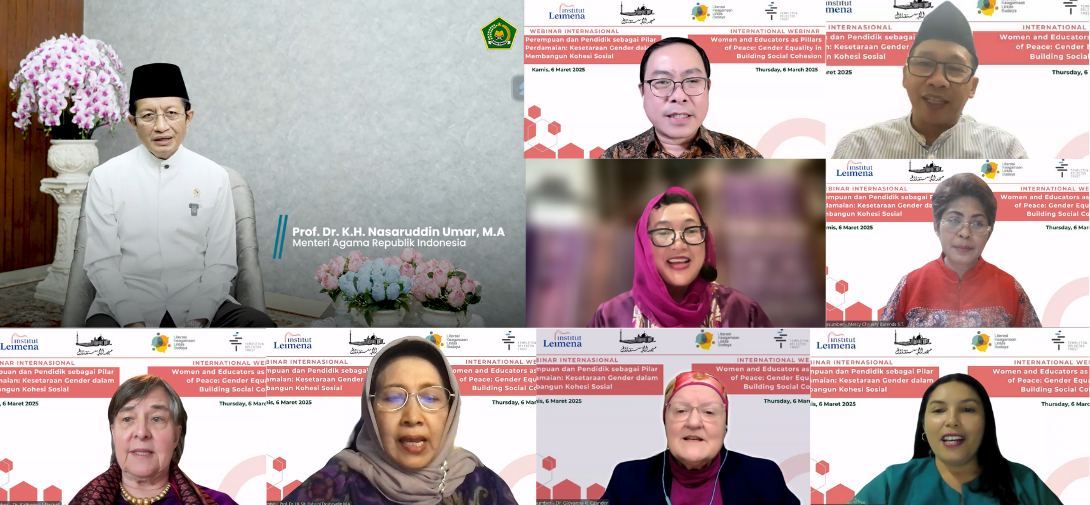
International Webinar Series on Cross-Cultural Religious Literacy in Commemoration of International Women’s Day features keynote speaker, Minister of Religious Affairs of the Republic of Indonesia, Nasaruddin Umar.
Jakarta, LKLB News – International Women’s Day, commemorated globally every March 8, underscores the importance of advancing gender equality as a fundamental human right. Women have a strategic role in fostering values of tolerance and social cohesion within society, which contributes significantly to sustaining global peace and sustainable development.
This message was conveyed during the International Webinar Series on Cross-Cultural Religious Literacy in commemoration of International Women’s Day, organized by the Leimena Institute and Istiqlal Mosque under the theme “Women and Educators as Pillars of Peace: Gender Equality in Building Social Cohesion” on March 6, 2025.
Indah Nuria Savitri, Director of Human Rights and Humanitarian Affairs at the Directorate General for Multilateral Cooperation, Ministry of Foreign Affairs of the Republic of Indonesia, stated that peace will be more sustainable when women participate actively in achieving it.
The United Nations has two instruments for ensuring gender equality and advancing women as agents of peace: the Beijing Declaration and Platform for Action (1995) and UN Security Council Resolution (UNSCR) 1325 on Women, Peace, and Security (2000).
“According to data, 35% of peace agreements can last at least 15 years if women are actively involved. This shows that women’s presence in peace processes, in diplomacy, is not merely symbolic, but a necessity,” said Indah
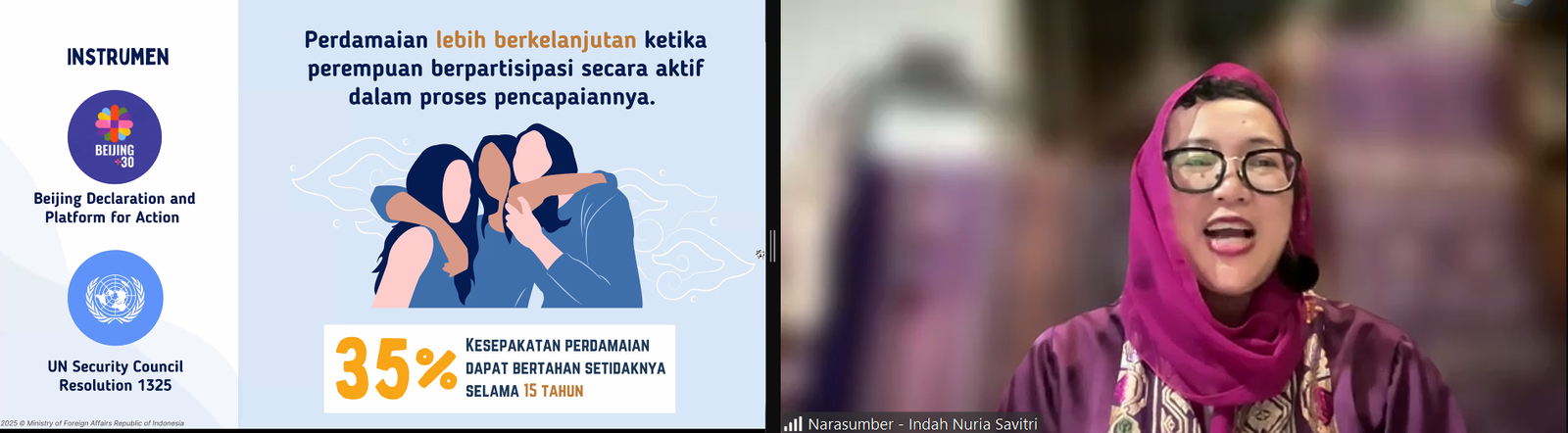
Director of Human Rights and Humanitarian Affairs, Directorate General of Multilateral Cooperation, Ministry of Foreign Affairs of the Republic of Indonesia, Indah Nuria Savitri.
Minister of Religious Affairs, Nasaruddin Umar, as keynote speaker at the webinar, emphasized that women’s empowerment thus far is still not sufficient. He stressed that men and women are both khalifah on earth—both servants of Allah SWT—therefore religion should serve to strengthen women’s dignity.
“On this very important occasion, I wish to call upon all of us to improve gender-biased interpretations of the Qur’an. Let us reexamine the wording as understood through the texts of hadith. We firmly believe that Allah SWT, like Rasulullah, makes no distinction between men and women,” said Nasaruddin Umar, Minister of Religious Affairs and concurrently Grand Imam of Istiqlal Mosque.
He added that both men and women have the right to be active leaders, whether in the household or in the public sphere, including as state leaders. He cited Qur’anic examples of female leadership, such as Queen Bilqis, ruler of the Kingdom of Saba, whose reign was blessed by God, making her land prosperous.
Nasaruddin also highlighted Khadijah, wife of Prophet Muhammad SAW, a noblewoman who became head of the household during their years in Mecca. Another verse refers to men as protectors of women (QS An-Nisa: 34).
“Stop discrediting women in the name of religion. Now is the time for us to find ways to empower women as one of the nation’s strengths, especially for Indonesia,” he urged.
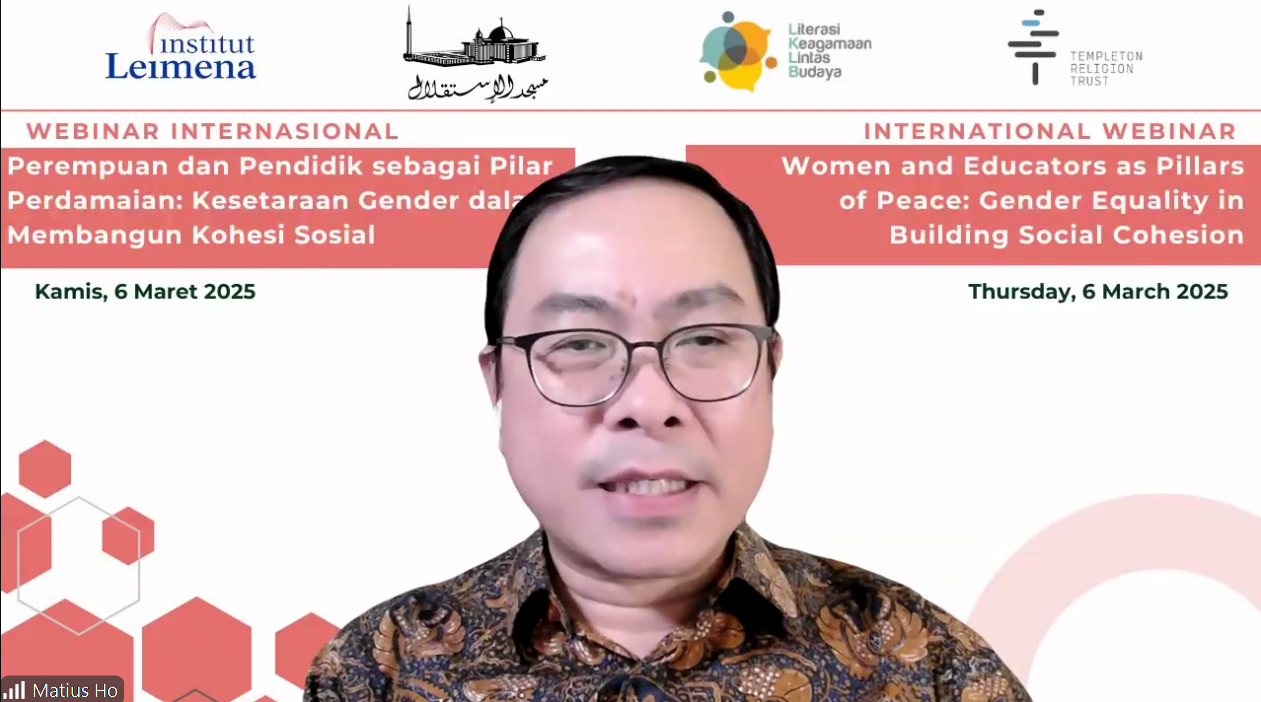
Matius Ho, Executive Director of the Leimena Institute
Matius Ho, Executive Director of the Leimena Institute, explained that the Cross-Cultural Religious Literacy (CCRL) program run by the Leimena Institute together with Istiqlal Mosque and dozens of other partners seeks to strengthen social cohesion, harmony, and peace in a plural society. Since its inception in late 2021, the program has graduated 62 cohorts with a total of more than 9,000 teachers, including 56% women educators.
“Teachers play a vital role as agents of peace in guiding the next generation to counter intolerant teachings that divide society and to foster mutual trust among followers of different religions and beliefs,” said Matius.
He continued that the theme “Women and Educators as Pillars of Peace” reminded him of three female educators from eastern Indonesia. Two were participants of the CCRL program from Ambon, Maluku: Sarlota Singerin, Principal of Rehoboth Christian High School and Chairperson of the Dr. JB. Sitanala Christian Education Foundation, and another female teacher. Together, they reached out to Jaleha Sangadji, Principal of AL HILAAL High School under the Islamic Al Hilaal Foundation in Ambon, to initiate the Sekolah Gandong declaration. In Maluku society, gandong is a revered customary bond of brotherhood.
“This is highly important for strengthening peace in Maluku, which some 20 years ago suffered from tragic social conflict,” said Matius.
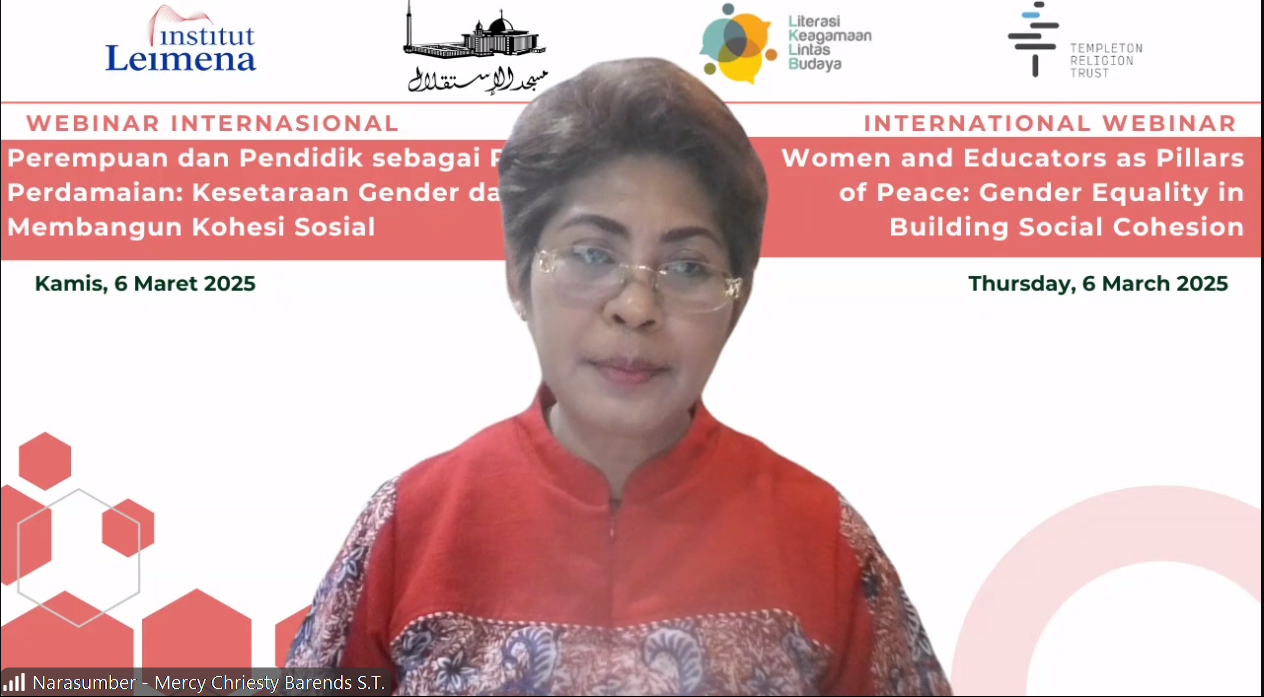
Mercy Chriesty Barends, Member of the House of Representatives of the Republic of Indonesia
Farid F. Saenong, Deputy Director of Voice of Istiqlal and Special Staff to the Minister of Religious Affairs, said that women’s issues and gender equality are integral to the values and principles promoted at Istiqlal Mosque. One example is the Pendidikan Kader Ulama (PKU) program, which includes specific classes for female participants.
“The PKU program has regular participants, and we specifically opened classes for women so that they could receive Islamic scholarship training. This idea quickly gained wide recognition—even Al-Azhar University in Cairo, Egypt, adopted our strategy,” said Farid.
Mercy Chriesty Barends, Member of the House of Representatives, stressed that social and structural injustices often marginalize women’s rights. Therefore, strong gender-responsive policies are needed to enhance women’s quality of life.
Siti Ruhaini Dzuhayatin, Professor of Human Rights and Gender at Sunan Kalijaga State Islamic University Yogyakarta, added that Cross-Cultural Religious Literacy provides a pedagogical approach to teaching peace in schools. Tolerance and moderation, which often remain at the conceptual level, can be translated into concrete practices through CCRL programs.
Katherine Marshall, Vice President of the G20 Interfaith Association, emphasized the distinctive qualities of women’s leadership—such as cooperation, empathy, and attentive listening—which are particularly vital in times of crisis. Meanwhile, Giovanna R. Czander, Visiting Researcher at the Institute of Religion, Law and Lawyer’s Work, Fordham University, New York, stressed the importance of law in guaranteeing gender equality.