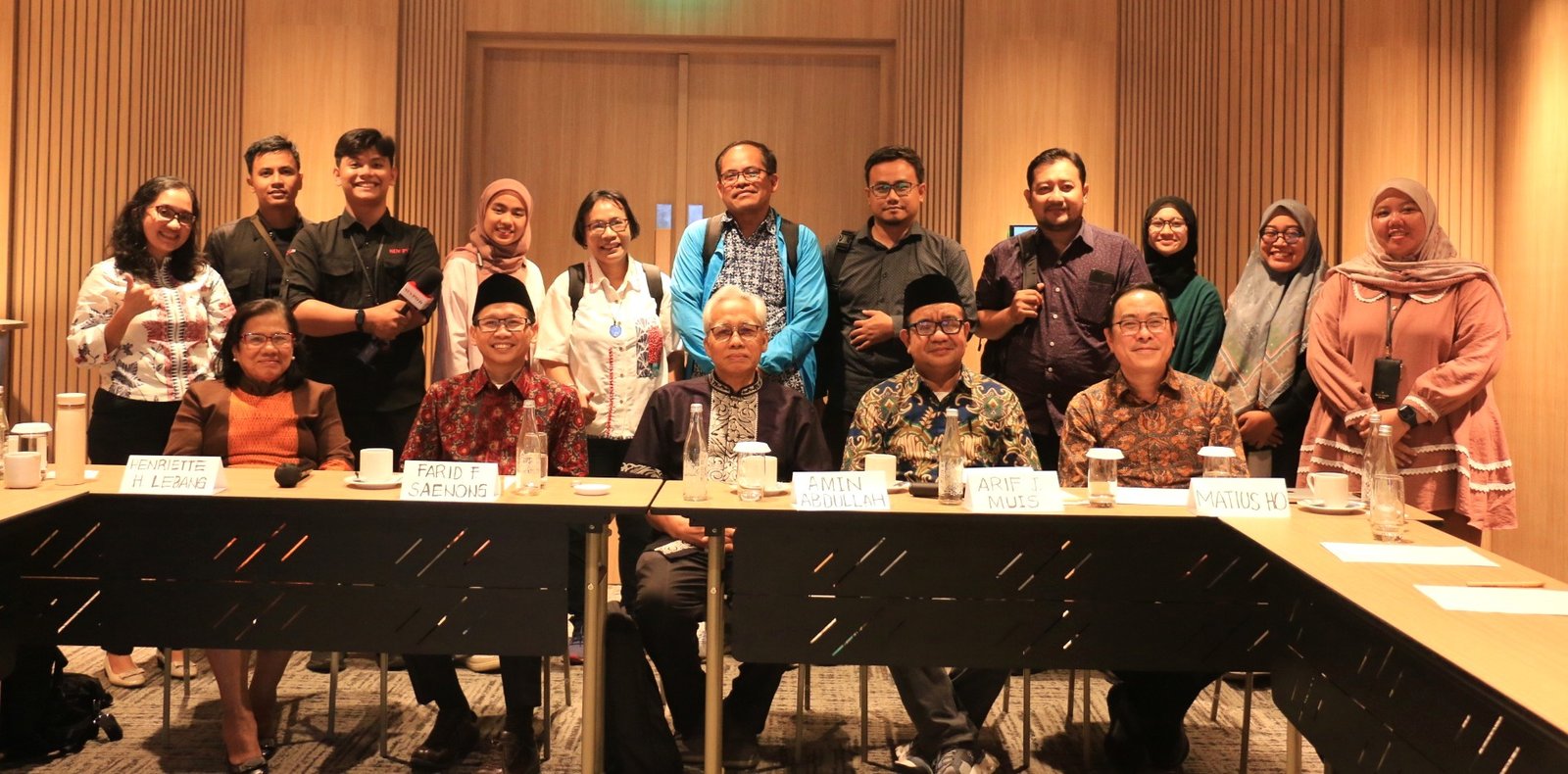
Speakers and media present at the media gathering and iftar hosted by the Leimena Institute, March 21, 2025.
Jakarta, LKLB News – The government, through the Ministry of Primary and Secondary Education (Kemendikdasmen) and the Ministry of Religious Affairs (Kemenag), is seeking to improve the education system through deep learning methods and the Curriculum of Love. The implementation of both concepts is considered to require strengthening teachers’ competencies, one of which can be done through the Cross-Cultural Religious Literacy (CCRL) program.
This was conveyed by a Member of the Steering Committee of the Pancasila Ideology Development Agency (BPIP), Amin Abdullah, at the Leimena Institute’s media gathering on Friday (March 21, 2025). This was the second such gathering, the first held on June 10, 2024. The purpose of the media gathering was to strengthen the Leimena Institute’s relationship with the press as an important pillar in realizing its mission of fostering mutual respect and cooperation in Indonesia’s plural society.
Other speakers included Special Staff to the Minister of Primary and Secondary Education, Arif Jamali Muis; Coordinator of the Minister of Religious Affairs’ Special Staff, Farid F. Saenong; World Council of Churches Presidium Member, Henriette Lebang; and Leimena Institute Executive Director, Matius Ho.
“The Cross-Cultural Religious Literacy program trains teachers to have competencies in multiculturalism, multireligiosity, and in our experience, out of more than 9,000 teachers trained, almost all had never even heard of these competencies before,” said Amin Abdullah, who is also a Senior Fellow of the Leimena Institute, to media representatives present from outlets including Kompas Daily, Tempo, Medcom.id, Okezone, Viva.id, and Sinpo TV.
Amin explained that the CCRL program also supports BPIP in reviving Pancasila character in the younger generation through the Core Textbook (BTU) of Pancasila Education for teachers and students. In CCRL, teachers are trained in three competencies for building relationships with people of different religions and cultures: personal competence (understanding one’s own religion comprehensively), comparative competence (understanding other religions in order to interpret relations with those of different beliefs), and collaborative competence (working together regardless of differences).
Amin said that deep learning methods encourage teachers to implement joyful learning, and CCRL competencies can support this by fostering education filled with values of tolerance, respect for others, and cooperation. Similar ideas are also found in the Curriculum of Love, which teaches religious practice with compassion.
“The combination of personal competence and comparative competence aims at collaborative competence. Thus, in Indonesia’s plural society, there must be no hatred toward followers of other religions. No religion should allow hatred toward others or declaring them infidels,” Amin said.
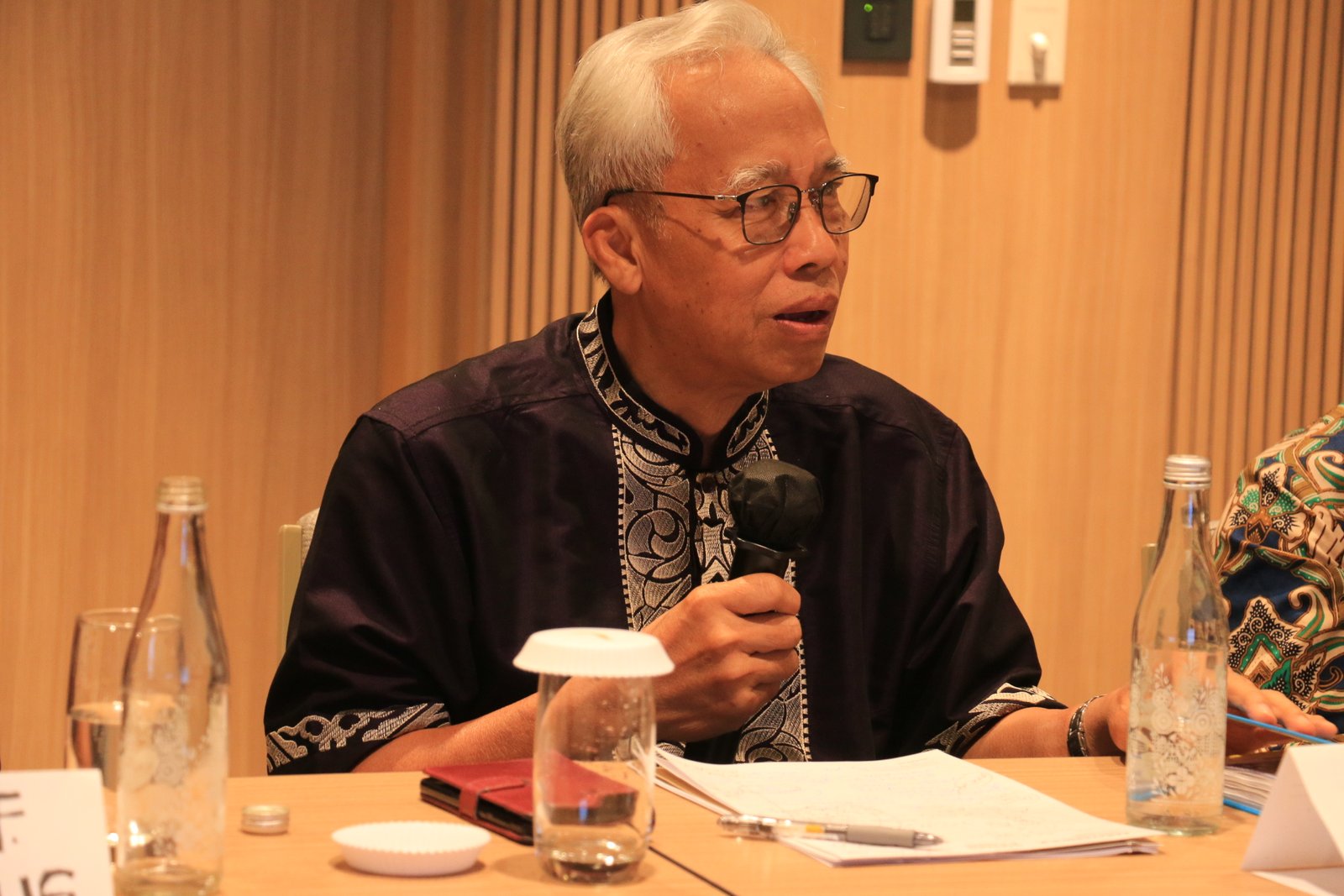
Prof. Dr. Amin Abdullah, Member of the BPIP Steering Committee and Senior Fellow of the Leimena Institute.
Special Staff to the Minister of Primary and Secondary Education, Arif Jamali, said that deep learning aims to enrich teaching approaches by adding pedagogical characteristics. In line with cross-cultural religious literacy competencies, the implementation of deep learning ensures that all parties involved respect one another while considering human potential, dignity, and values.
“Deep learning is an ennobling approach that emphasizes the creation of a learning atmosphere and process that is conscious, meaningful, and joyful through holistic development of the mind, heart, feelings, and body,” said Arif.
Meanwhile, Coordinator of the Minister of Religious Affairs’ Special Staff, Farid F. Saenong, said that three key government figures are the main collaborators in the CCRL program, which began in 2021: BPIP Steering Committee Member Amin Abdullah, Minister of Religious Affairs Nasaruddin Umar, and Minister of Primary and Secondary Education Abdul Mu’ti. Therefore, the Curriculum of Love is a momentum to further strengthen teachers’ competencies through the CCRL program.
“This will become a major strength that we must use positively, so that our shared aspiration for peaceful, tolerant life in Indonesia can be realized,” Farid said.
Farid added that the Curriculum of Love is essentially the substance, values, character, and content that will dominate all teaching and learning processes. The Curriculum of Love is still in the public consultation stage, meaning it is still open to input from various parties. The concept emphasizes building relationships to safeguard national unity.

The role of the media is crucial in raising public awareness of values of mutual respect and cooperation among people of different faiths.
Leimena Institute Executive Director, Matius Ho, said the CCRL program aims to build social capital in a plural society, namely mutual trust. He explained that the relationship between trust and cooperation is like a circle: mutual trust enables cooperation, and cooperation strengthens trust.
“If a plural society enters a negative circle, social disintegration can occur quickly. That is why the CCRL program seeks to encourage a positive circle—strengthening cooperation to build trust. Hopefully, this approach will support the programs of the Ministry of Religious Affairs and the Ministry of Primary and Secondary Education,” said Matius Ho.
Matius said the CCRL program has been implemented extensively, with 9,383 educators trained across 37 provinces of Indonesia. Teachers involved are encouraged to concretely apply CCRL competencies in their classrooms.
World Council of Churches Presidium Member, Henriette Lebang, added that the Curriculum of Love encourages religious lessons to touch the spirituality of students. Religion should not merely be memorized, but lived, including in relationships with those who are different. Meanwhile, deep learning encourages students to be aware of plurality, including their own and others’ potential.
“The Curriculum of Love and deep learning are actually efforts to change paradigms in education. Education is not about the curriculum per se, but more about the content and values to be built,” said Henriette.