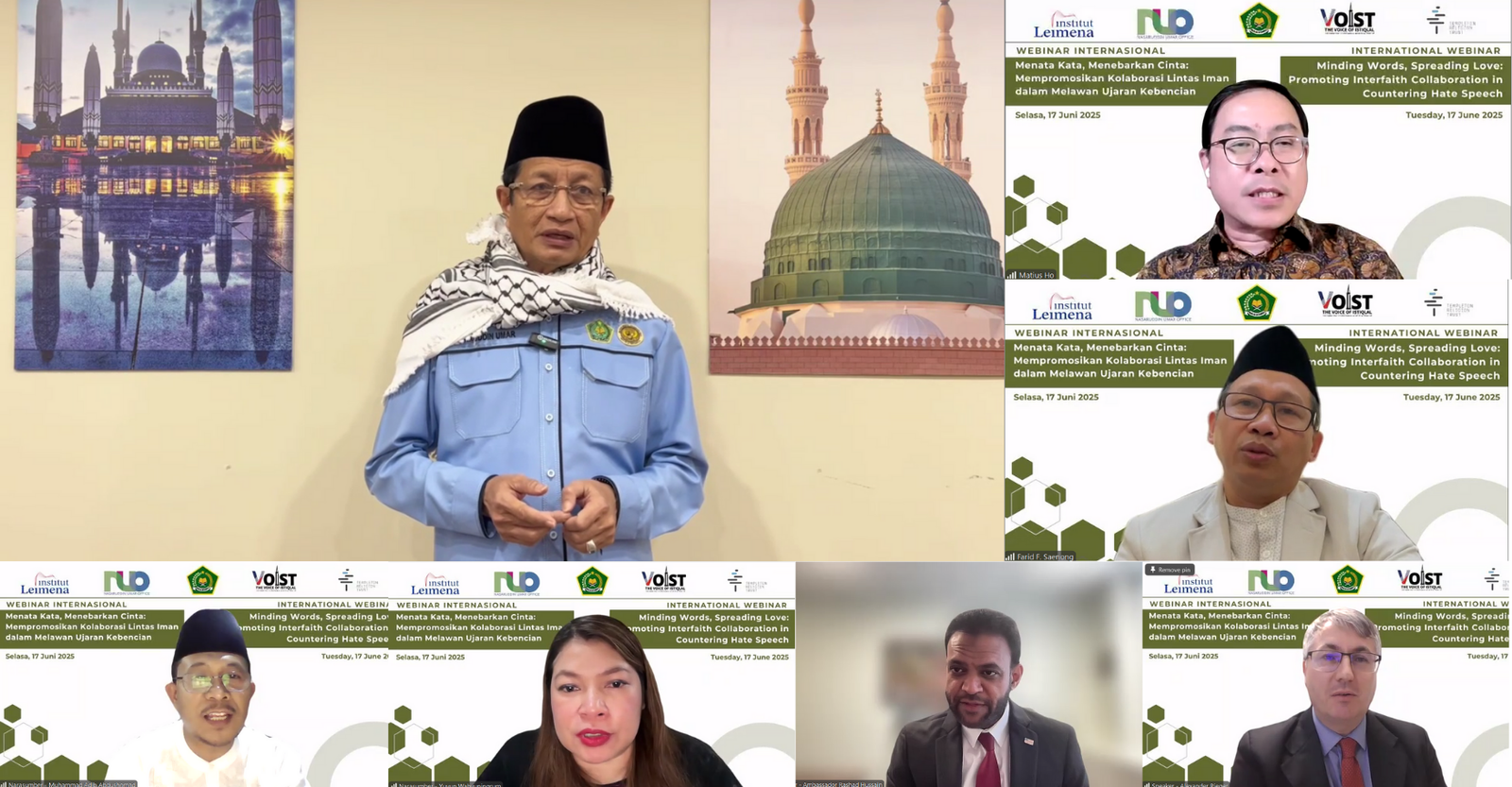
Minister of Religious Affairs of the Republic of Indonesia, Nasaruddin Umar, together with Chief of Staff of the Minister of Religious Affairs, Farid F. Saenong, and Executive Director of Leimena Institute, Matius Ho, along with fellow speakers of the International Day for Countering Hate Speech Webinar, Tuesday, June 17, 2025.
Jakarta, LKLB News – The International Day for Countering Hate Speech, observed every June 18, serves as a reminder to remain vigilant against the threat of hate speech, especially amid the increasingly massive flow of digital information. Hate speech, particularly when based on religion, is considered one of the most potent triggers of conflict and division in a pluralistic global society, including in Indonesia.
This was highlighted in the International Webinar Series on Cross-Cultural Religious Literacy (CCRL), organized by the Ministry of Religious Affairs of the Republic of Indonesia, Voice of Istiqlal, the Nasaruddin Umar Office, and the Leimena Institute, in commemoration of the International Day for Countering Hate Speech on Tuesday, June 17, 2025. The webinar was attended by more than 2,900 participants from around 14 countries and over 400 cities.
“We must be vigilant against hate speech with religious themes, religious hate speech, because its impact is enormous, like dry grass doused with gasoline,” said Minister of Religious Affairs Nasaruddin Umar, who was the keynote speaker in the webinar themed “Shaping Words, Spreading Love: Promoting Interfaith Collaboration in Countering Hate Speech.”
Minister Nasaruddin emphasized that the escalation of religious-based hate speech is rapid and far-reaching. He reminded that psychological and spiritual maturity in religious life is essential so that people are not easily provoked into religious hostility.
“If we love this nation, love peace, love the world and humanity, let us restrain our mouths. Let us restrain our fingers from easily spreading hate speech or forwarding hate-filled messages,” the Minister urged.
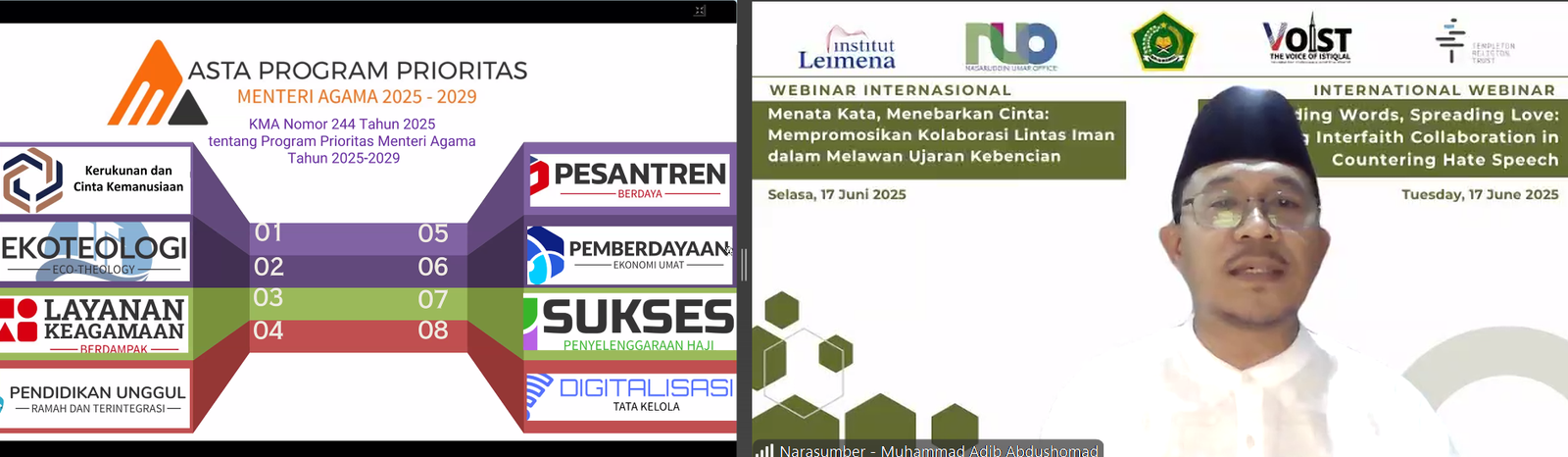
Head of the Center for Religious Harmony (PKUB) of the Ministry of Religious Affairs, Muhammad Adib Abdushomad.
Executive Director of Leimena Institute, Matius Ho, said that hate speech has become a serious problem threatening social harmony and diversity in today’s global world. The International Day for Countering Hate Speech, established by a UN General Assembly resolution in 2021 entitled “Promoting interreligious and intercultural dialogue and tolerance in countering hate speech,” highlights global concerns about the spread of hate speech, disinformation, and misinformation.
Matius explained that misinformation refers to false or inaccurate information regardless of intent, while disinformation is false information deliberately spread to mislead. According to him, both disinformation and misinformation serve as sparks as well as fuel for hate speech, making vigilance all the more necessary.
“Do not assume that because we are a religious society, devout in our faith, we are somehow immune. On the contrary, we must be extra cautious, because disinformation and misinformation cloaked in religious labels can easily inflame emotions, erase reason, and unleash various forms of hate speech,” said Matius.
He added that the Cross-Cultural Religious Literacy (CCRL) approach, which emphasizes strengthening competencies and skills to build relationships and interfaith collaboration, is essential for countering religious-based hate speech. The three CCRL competencies—personal, comparative, and collaborative—help cultivate mutual trust as social capital in pluralistic societies.
“Since 2021, in cooperation with Istiqlal Mosque and many other institutions, we at the Leimena Institute have been developing the CCRL program for teachers and educators. The alumni now number 10,000 people spread across 38 provinces in Indonesia,” Matius explained.

Senior Fellow in Comparative Religion, University of Washington, USA, Chris Seiple.
Faithful Responsibility
Chris Seiple, Senior Fellow in Comparative Religion at the Jackson School of International Studies, University of Washington, stated that discussions about religious-based hate speech must be approached from the perspective of faithful responsibility in interpreting those who are different. In CCRL, one of the core competencies is personal, which involves learning about one’s own beliefs in order to interact with people of other faiths.
“As with the Love Curriculum, the CCRL approach also has the acronym ‘LOVE’ — listen, observe, verify, and engage. That means listening and observing with the heart, verifying with our mind, and engaging, extending a hand to work together,” Seiple said.
Seiple quoted a saying that only the best of our faith can overcome the worst of our religion. Many traditions have used religion as a vehicle for hatred, but true faith is humility before God. Within this context, CCRL’s personal competency plays a role in overcoming hatred.
Meanwhile, Head of the Center for Religious Harmony (PKUB) of the Ministry of Religious Affairs, Muhammad Adib Abdushomad, noted that Minister Nasaruddin has placed harmony and love for humanity as the foremost priority of the Ministry of Religious Affairs through the Eight Priority Programs (Asta Protas). One of its implementations is the Love-Based Curriculum (KBC), which in PKUB specifically takes the form of an Interfaith Love-Based Curriculum.