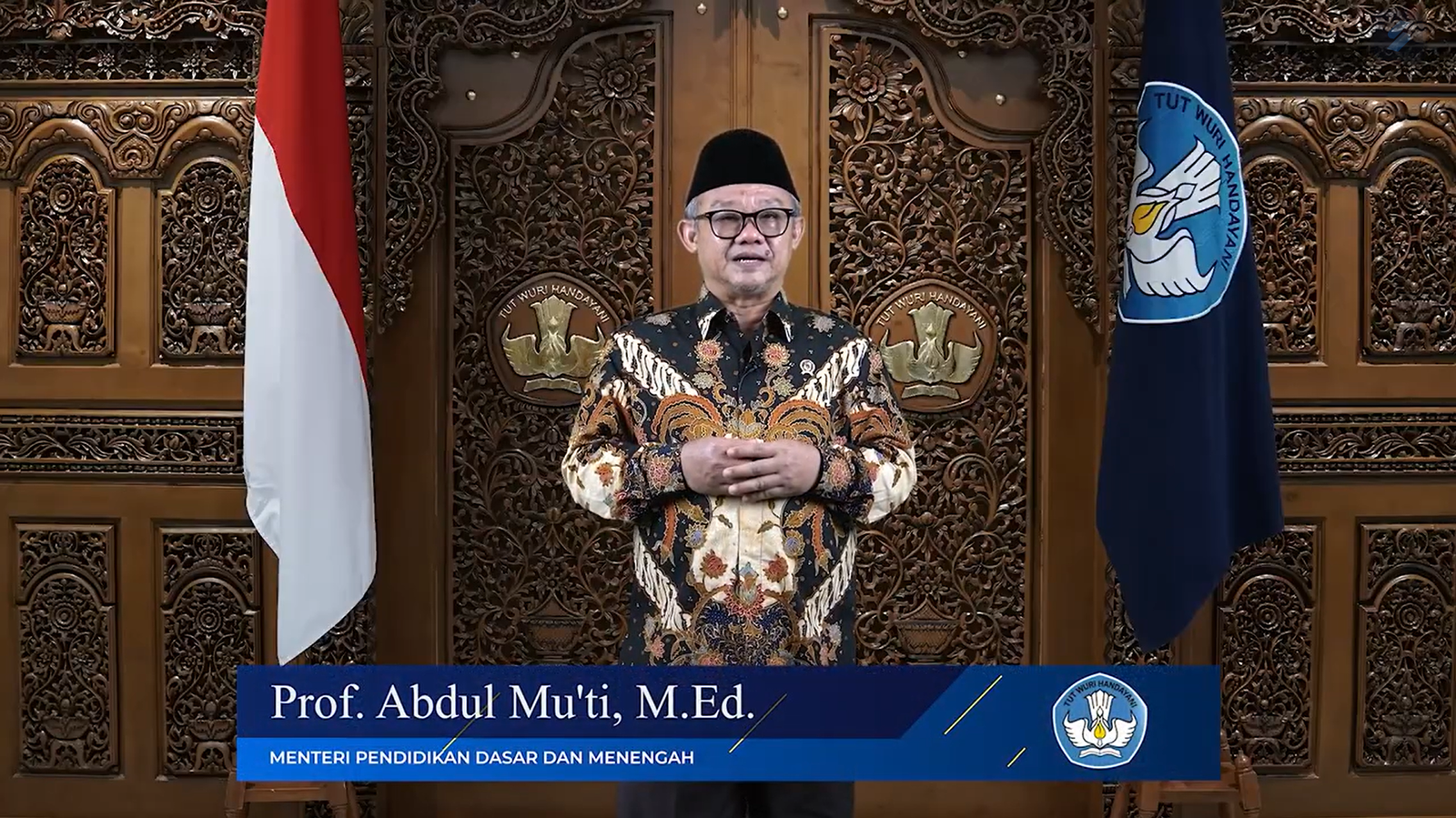
Minister of Primary and Secondary Education of the Republic of Indonesia, Abdul Mu’ti, at the International Webinar Series on Cross-Cultural Religious Literacy commemorating National Education Day, organized by the Center for Character Strengthening of the Ministry of Primary and Secondary Education (Kemendikdasmen RI) together with the Leimena Institute, June 29, 2025.
Jakarta, LKLB News – Efforts to strengthen character education carried out by the Ministry of Primary and Secondary Education of the Republic of Indonesia (Kemendikdasmen RI) through the “7 Habits of Great Indonesian Children” program are essential to building peace and social harmony in a pluralistic society.
Minister of Primary and Secondary Education (Mendikdasmen) of the Republic of Indonesia, Abdul Mu’ti, in the International Webinar Series on Cross-Cultural Religious Literacy commemorating National Education Day, organized by the Center for Character Strengthening of Kemendikdasmen RI together with the Leimena Institute, said that Indonesian youth must grow not only in terms of academic achievement, but also with strong character values to build a tolerant and respectful life.
“We need to instill in our children a social attitude, where they are an inseparable part of society, and to build an inclusive social environment,” said Abdul Mu’ti in the webinar themed “Sowing Character, Reaping Civilization: Building the Habits of Great Indonesian Children” attended by more than 3,400 participants from within and outside Indonesia on the evening of Tuesday, June 29, 2025.
The Minister emphasized that character education, as mandated by the Constitution and the National Education System Law, is not only related to formal learning in schools but also to family-based learning, community-based learning, and even the mass media.
“I welcome the holding of this seminar as part of our joint efforts to build a harmonious and peaceful religious life, and as our shared endeavor to build a generation that has love and concern for fellow human beings,” said Abdul Mu’ti.
Head of the Center for Character Strengthening (Puspeka) of Kemendikdasmen RI, Rusprita Putri Utami, said that history records that the character of a nation is the foundation of great civilizations of the world, starting from ancient Greece which gave birth to the spirit of critical thinking and ethics as the basis of democracy and philosophy. Rusprita added that post-World War II Japan also rose to become a developed country because of strong character traits such as discipline, respect, and perseverance.
“Indonesia has Pancasila, which is the identity and character of the nation, serving as a moral compass in national and state life amidst diversity,” said Rusprita.
She explained that the CCRL webinar series in commemoration of National Education Day serves as a platform for sharing insights, exchanging experiences, and exploring collaborative strategies to promote quality education for all.
“The next generation needs to be equipped not only to think critically but also to live ethically with compassion through literacy that transcends cultural and religious boundaries,” said Rusprita.
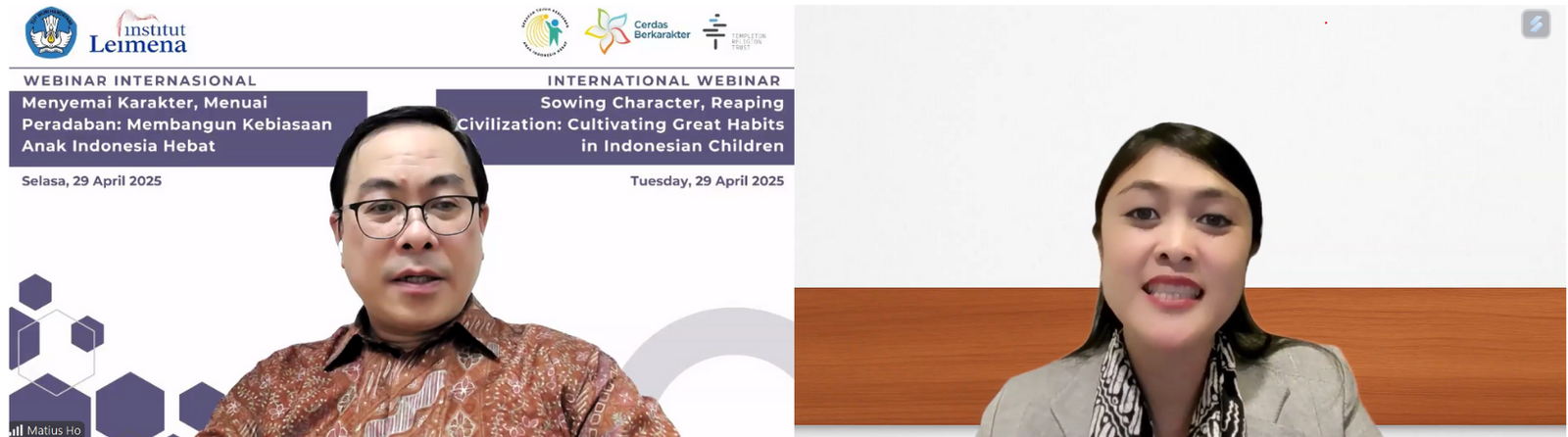
Executive Director of the Leimena Institute, Matius Ho, and Head of the Center for Character Strengthening of the Ministry of Primary and Secondary Education of the Republic of Indonesia, Rusprita Putri Utami.
Meanwhile, Executive Director of the Leimena Institute, Matius Ho, said that all parties need to be involved in efforts to build the mental and character foundation of the nation through the program to instill the habits of great Indonesian children. In this context, the Leimena Institute continues to develop the Cross-Cultural Religious Literacy (CCRL) approach to help support character education by enhancing teachers’ competencies.
“With the ‘7 Habits of Great Indonesian Children’ program, we will strive to ensure that the CCRL program can contribute to this great and important task of building the mental and character foundation of the Indonesian nation in the midst of an increasingly polarized global society,” said Matius.
Matius explained that the CCRL program, developed by the Leimena Institute together with more than 30 educational and religious partner institutions, seeks to strengthen the competencies needed in a pluralistic society, as well as open spaces for interfaith encounters so that people can get to know and learn from one another.
As an example, 2 of the “7 Habits of Great Indonesian Children” are the habits of being obedient in worship and being active in the community. The CCRL program is based on the understanding that for a person of faith, loving God and loving fellow human beings must go hand in hand.
“In the context of a religious and pluralistic society, being obedient in worship does not mean isolating oneself from the wider community, but also being able to build social capital and mutual trust among followers of different religions and beliefs,” Matius continued.
Since it began in 2021 until now, the CCRL program has graduated 64 cohorts with a total of 9,600 educators from 38 provinces. The CCRL program is attended by teachers from diverse religious backgrounds, including Islam, Christianity, Buddhism, Hinduism, and Confucianism.