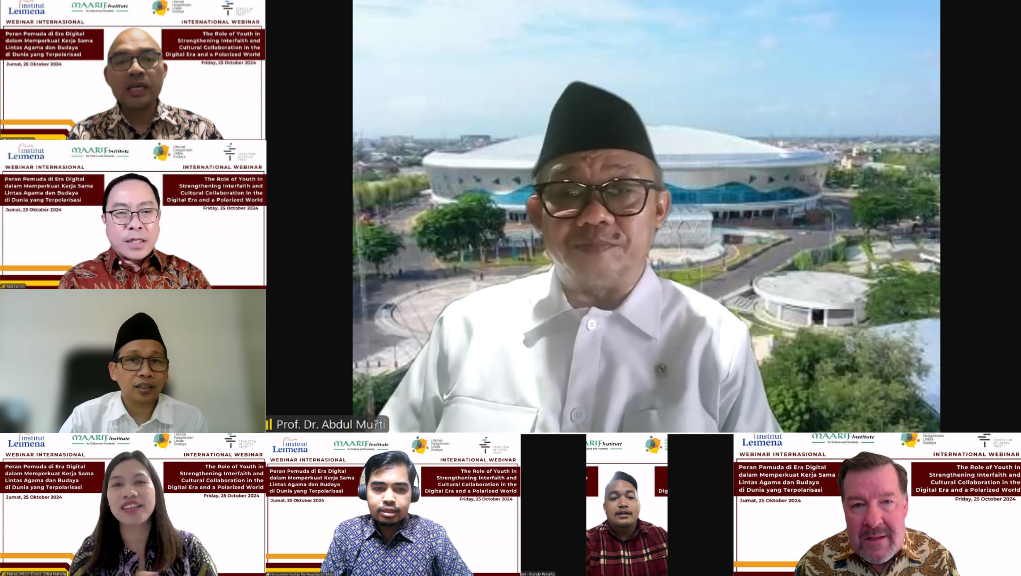
Minister of Primary and Secondary Education of the Republic of Indonesia, Prof. Dr. Abdul Mu’ti, together with keynote speakers, Executive Director of the Maarif Institute, Andar Nubowo, and Executive Director of the Leimena Institute, Matius Ho, as well as panelists in the Cross-Cultural Religious Literacy (CCRL) Webinar Series in commemoration of Youth Pledge Day, Friday (October 25, 2024).
Jakarta, CCRL News – The Minister of Primary and Secondary Education of the Republic of Indonesia (Mendikdasmen RI), Prof. Dr. Abdul Mu’ti, reminded the youth of their role as a unifying force in facing the challenge of polarization in the digital era. The historic Youth Pledge of October 28, 1928, has become proof of the birth of the Indonesian spirit, even though at that time Indonesia had not yet been established as a state and remained divided by ethnicity, race, religion, and language.
“The momentum of the Youth Pledge commemoration is an important reminder of the role of young people in advancing their nation and country, and of how essential their role is as a unifying force,” said the Minister in the International Webinar Series on Cross-Cultural Religious Literacy (CCRL) commemorating Youth Pledge Day, organized by the Maarif Institute and the Leimena Institute under the theme ‘The Role of Youth in the Digital Era in Strengthening Interfaith and Intercultural Cooperation in a Polarized World’, Friday evening (October 26, 2024).
Abdul Mu’ti joined at the end of the webinar, as he was attending a retreat for the new cabinet, Merah Putih, under the administration of President Prabowo Subianto at the Military Academy complex, Magelang.
“First of all, I apologize for not being able to attend from the beginning. I just finished an event with President Prabowo Subianto in Magelang, at the Military Academy complex,” he said.
Abdul Mu’ti, who is also still serving as the Secretary-General of the Central Board of Muhammadiyah, said that the Youth Pledge, which will be commemorated on October 28, is a historic milestone in Indonesia’s journey toward independence. The Youth Pledge became a foundation for Indonesia’s sovereignty in terms of cultural sovereignty, political sovereignty, and territorial sovereignty.
Cultural sovereignty was manifested in the agreement of youth from various religious and regional organizations to declare one homeland, Indonesia; one nation, Indonesia; and to uphold one unifying language, Indonesian. Abdul Mu’ti noted that there is no precedent for a country like Indonesia, which has more than 700 regional languages, over 300 ethnic groups, and thousands of islands both large and small.
Political sovereignty meant that the Youth Pledge became the momentum for Indonesia to declare its independence politically. Meanwhile, territorial sovereignty was marked by Indonesia’s recognition as an archipelagic state after the long struggle of former Prime Minister Ir. Djuanda Kartawidjaja in various international political negotiations.
“In the context of history, I believe the Youth Pledge was a political achievement that was by no means easy, because at that time Indonesia still consisted of many kingdoms and a vast diversity of cultures and languages,” he said.
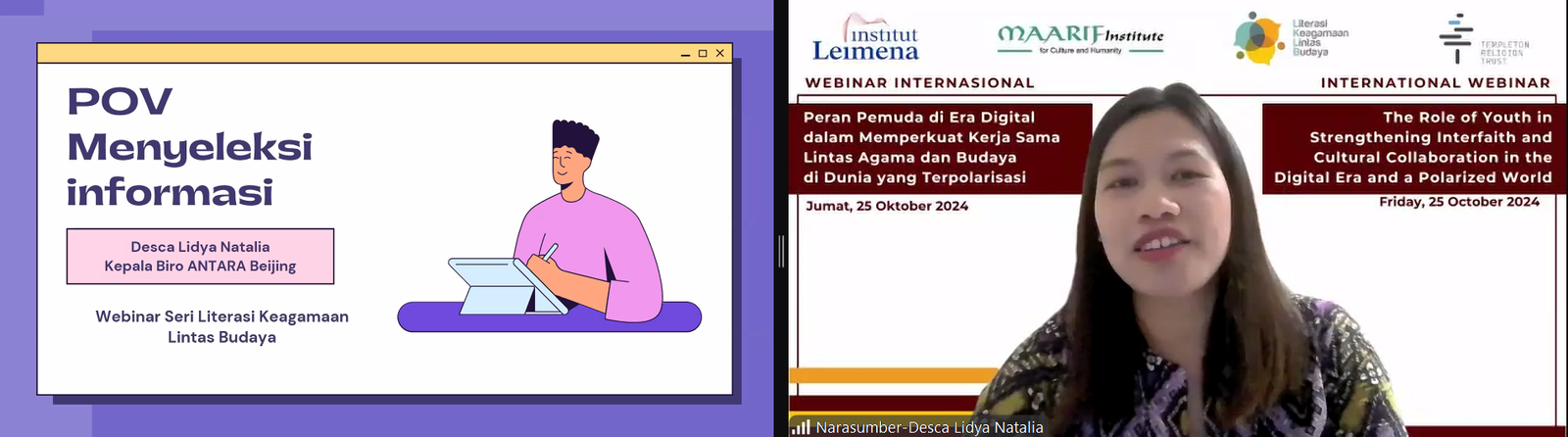
Head of ANTARA Bureau Beijing, Desca Lidya Natalia
Meanwhile, the Head of the ANTARA Beijing Bureau in China, Desca Lidya Natalia, emphasized the importance of critical thinking skills in the midst of the flood of information in the digital era. She said that no single mainstream media or social media account is 100 percent accurate, as certain aspects are highlighted while others are left out.
“However, some accounts are certainly more reliable than others,” said Desca, who had previously been a journalist assigned to the Presidential Palace of the Republic of Indonesia.
Desca explained that misinformation is false information spread unintentionally, while disinformation is false information deliberately spread to deceive, and half-truth is information that is partly true but presented in a misleading way. She encouraged a critical mindset when consuming digital information, such as using fact-checking tools like https://cekfakta.com/, considering the credentials of authors and sources, comparing with credible media, and identifying bias and manipulative techniques.
She urged the public to continuously learn to recognize hoaxes or fake news, with indicators such as sensational headlines and unverified sources, irregularities in the use of fake images or deepfakes, and the importance of understanding the context of circulating information.
“Be a youth who is critical about information, for example by making your search goals more specific and ensuring that the information obtained leads to meaningful conversations, not endless debates or even hatred,” said Desca.
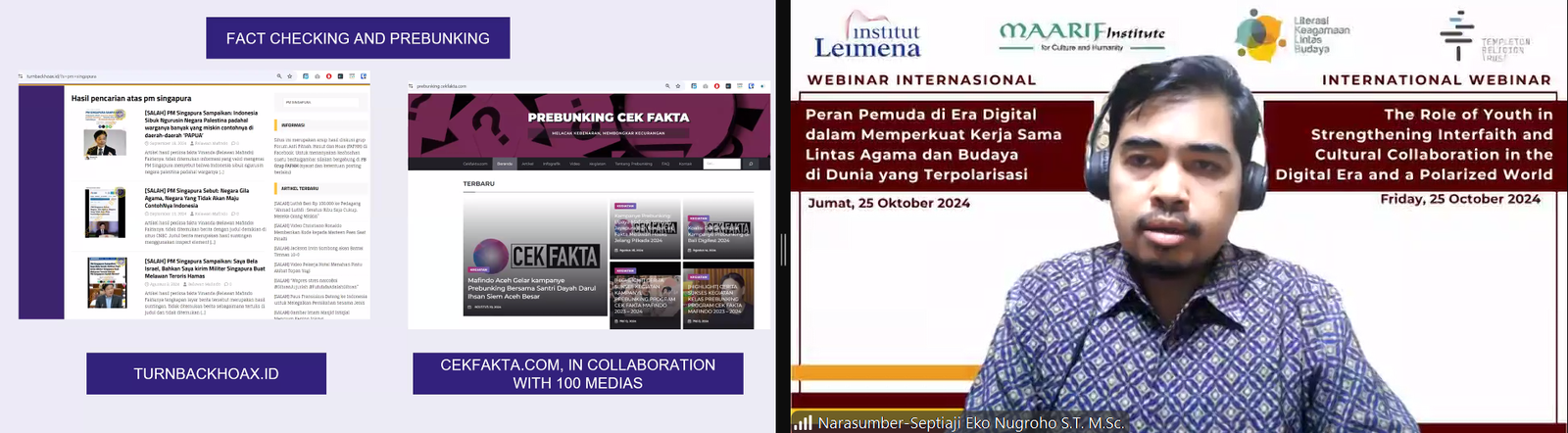
Chairman of the Presidium of the Indonesian Anti-Slander Society (Mafindo), Septiaji Eko Nugroho
The Chairman of the Presidium of the Indonesian Anti-Slander Society (Mafindo), Septiaji Eko Nugroho, said that Mafindo works to strengthen facts, truth, and trust amid the massive flow of information. Their efforts include providing tools for fact-checking and presumption, developing digital literacy education, building trust, and advancing technology.
“For fact-checking, we have the tools turnbackhoax.id and cekfakta.com, in collaboration with 100 media outlets,” said Septiaji.