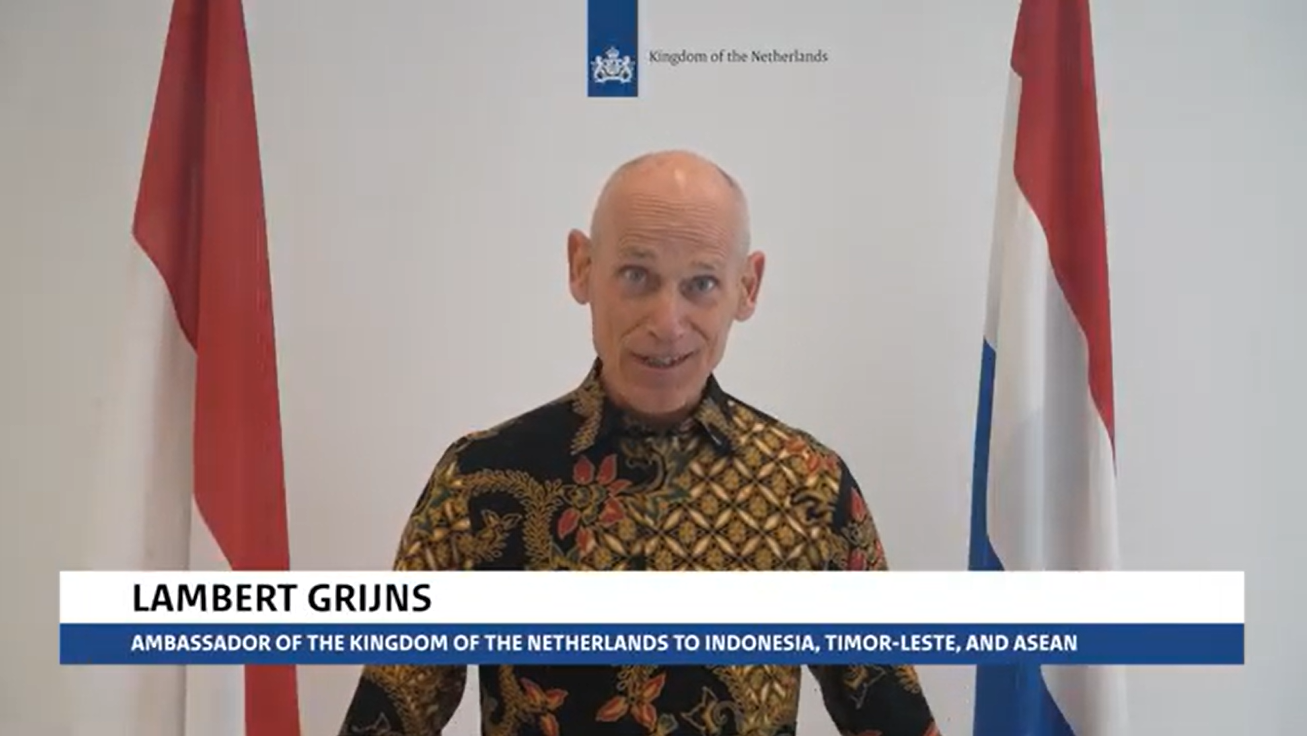
Ambassador of the Kingdom of the Netherlands, Lambert Grijns, delivering remarks at the International Webinar Series on Cross-Cultural Religious Literacy with the theme “Global Perspectives in Combating Intolerance and Discrimination Based on Religion or Belief”, Tuesday (August 22, 2023).
Jakarta, LKLB News – Indonesia and the Netherlands have a long tradition of safeguarding religious tolerance within society. Both countries are also bound by the same conviction to respect diversity.
This was conveyed by the Ambassador of the Kingdom of the Netherlands, Lambert Grijns, in the International Webinar Series on Cross-Cultural Religious Literacy with the theme “Global Perspectives in Combating Intolerance and Discrimination Based on Religion or Belief”, organized by the Embassy of the Netherlands in collaboration with the Leimena Institute, Tuesday (August 22, 2023).
Ambassador Grijns said that Indonesia, as a plural nation, is known for its tradition of gotong royong even with those of different faiths, while the Netherlands has the polder model as a consensus to set aside differences for the greater good.
“Although religion shapes our societies in different ways, the Netherlands and Indonesia are united in the same conviction that all citizens have the right to live free from discrimination,” said Ambassador Grijns.
He explained that religion plays a very important role in many aspects of social life. Indonesia is described as one of the most religious countries in the world, as religion is deeply embedded in daily life. For instance, in matters of banking, art, death, food, and others, which are aligned with Indonesia’s state foundation, Pancasila, especially its first principle, Belief in the One and Only God.
Similarly, Dutch society also lives in religious diversity, where Islam has grown to encompass 5% of the population, while the majority, more than 30%, are Christian.
“We are diverse nations that believe in respecting every human being as they are. There is richness and strength in diversity,” said Ambassador Grijns.
Meanwhile, Executive Director of the Leimena Institute, Matius Ho, said the theme of the webinar was inspired by UN Human Rights Council Resolution 16/18, which in full is entitled “Combating Intolerance, Negative Stereotyping and Stigmatization, and Discrimination, Incitement to Violence, and Violence Against Persons Based on Religion or Belief.”
“Human Rights Resolution 16/18 shows that the focus is not only on combating actions, but also the mindset. Combating actions alone is already difficult, let alone combating the mindset,” said Matius.
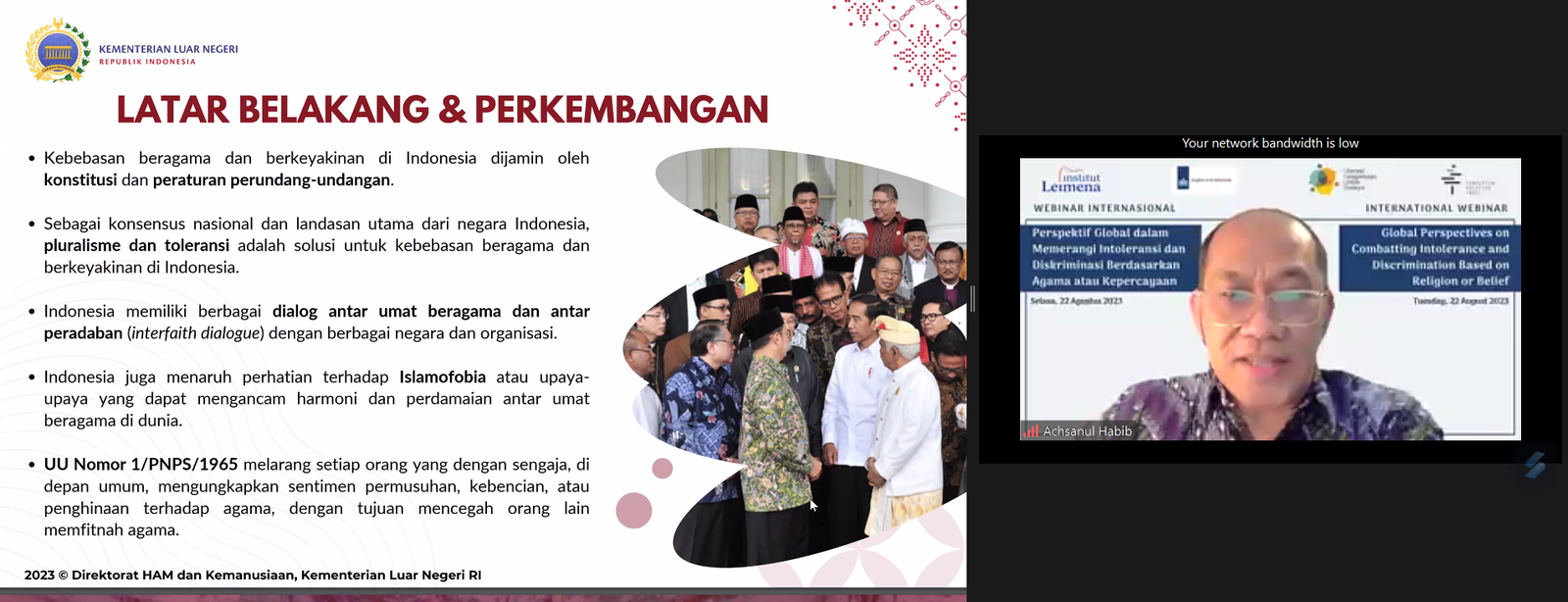
Director of Human Rights and Humanitarian Affairs, Ministry of Foreign Affairs of the Republic of Indonesia, Achsanul Habib, delivering a presentation.
The Challenge of Information Manipulation
According to Matius, the vast flow of information in today’s digital era poses a great challenge because of efforts to dominate human thinking through the manipulation of information and teachings that demean others merely for reasons of religion or belief.
He said that when someone’s mindset is dominated by fear or hatred toward others due to such misinformation or teachings, in truth the one whose dignity is demeaned is not only the other person, but also themselves. This is because such a mindset actually hinders one’s own growth as a human being with dignity.
“It is within this framework as well that the Cross-Cultural Religious Literacy training program for teachers and other educators is carried out by the Leimena Institute together with more than a dozen partner institutions,” said Matius.
He explained that the CCRL program seeks to develop competencies and skills for building relationships and cooperation with those of different religions and beliefs, so that together they may face the potential growth of mindsets and attitudes of fear or hostility merely because of religious or belief differences in a plural society.
Director of Human Rights and Humanitarian Affairs, Ministry of Foreign Affairs of the Republic of Indonesia, Achsanul Habib, said that Indonesia consistently supports the implementation of Resolution 16/18, which in principle emphasizes the importance of tolerance. He stressed that freedom of religion and belief in Indonesia is guaranteed by the constitution and legislation.
“As the national consensus and the main foundation of the Indonesian state, pluralism and tolerance are the solution for freedom of religion and belief in Indonesia,” said Achsanul.
Director of the International Center for Law and Religion Studies at Brigham Young University, Dr. Brett G. Scharffs, said that the situation of hate speech involves a simple relationship between the speaker and the target audience. Often, it is the audience of hate speech that becomes the accelerator or “fuel,” rather than cooling down the atmosphere.