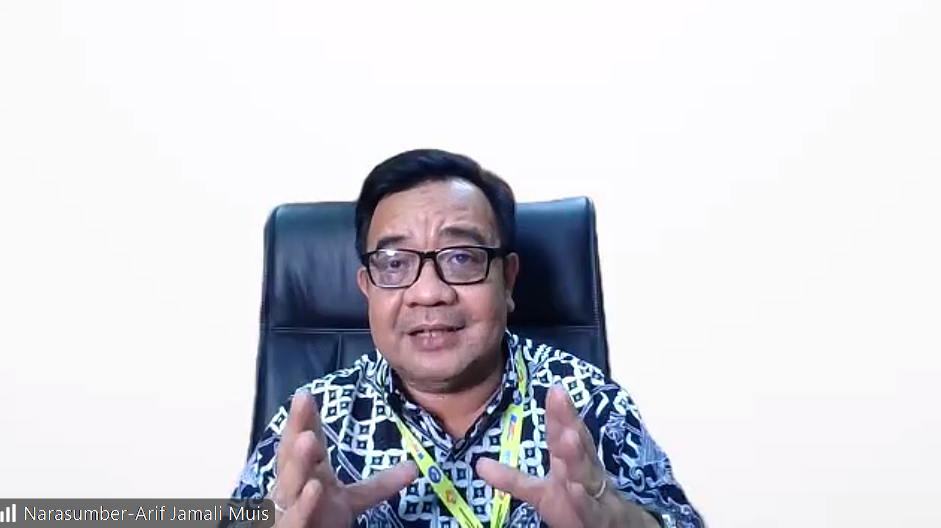
Arif Jamali Muis, Special Staff to the Minister of Primary and Secondary Education of the Republic of Indonesia, delivering his presentation at the International Webinar Series on Cross-Cultural Religious Literacy in commemoration of National Education Day, April 29, 2025.
Jakarta, LKLB News – The Special Staff to the Minister of Primary and Secondary Education of the Republic of Indonesia, Arif Jamali Muis, emphasized the importance of strengthening character education in building the civilization of a nation. This is the foundation for the Ministry of Primary and Secondary Education (Kemendikdasmen) of the Republic of Indonesia to strengthen character education through the movement of the Seven Habits of Great Indonesian Children, which include waking up early, worshiping, exercising, eating healthy and nutritious food, loving to learn, engaging in society, and sleeping early.
“These habits will psychologically form patterns in the brain which in turn will become character, and thus a good civilization can be realized,” said Arif in the International Webinar Series on Cross-Cultural Religious Literacy with the theme “Sowing Character, Reaping Civilization: Building the Habits of Great Indonesian Children” organized by the Center for Character Strengthening of the Ministry of Primary and Secondary Education RI and the Leimena Institute on Tuesday, April 29, 2025.
The 7 Habits of Great Indonesian Children (KAIH) movement is one of the breakthroughs by the Ministry of Primary and Secondary Education, launched in December 2024. According to Arif, the 7 KAIH movement is not a new curriculum, but rather an effort to encourage the nation’s future generations to apply positive daily habits, both at school and in the family.
Arif referred to neuroscience theory which states that habit formation is linked to the basal ganglia in the brain, a part that plays an important role in learning and memory, thereby forming habits. Furthermore, Arif stated that the implementation of 7 KAIH cannot rely solely on the government, but requires collaboration among the four centers of education: schools, families, communities, and media.
“These elements will form an ecosystem that enables the flourishing of positive character in children. We must carry this out together—through collective participation, we can realize a Golden Indonesia in 2045,” Arif said.
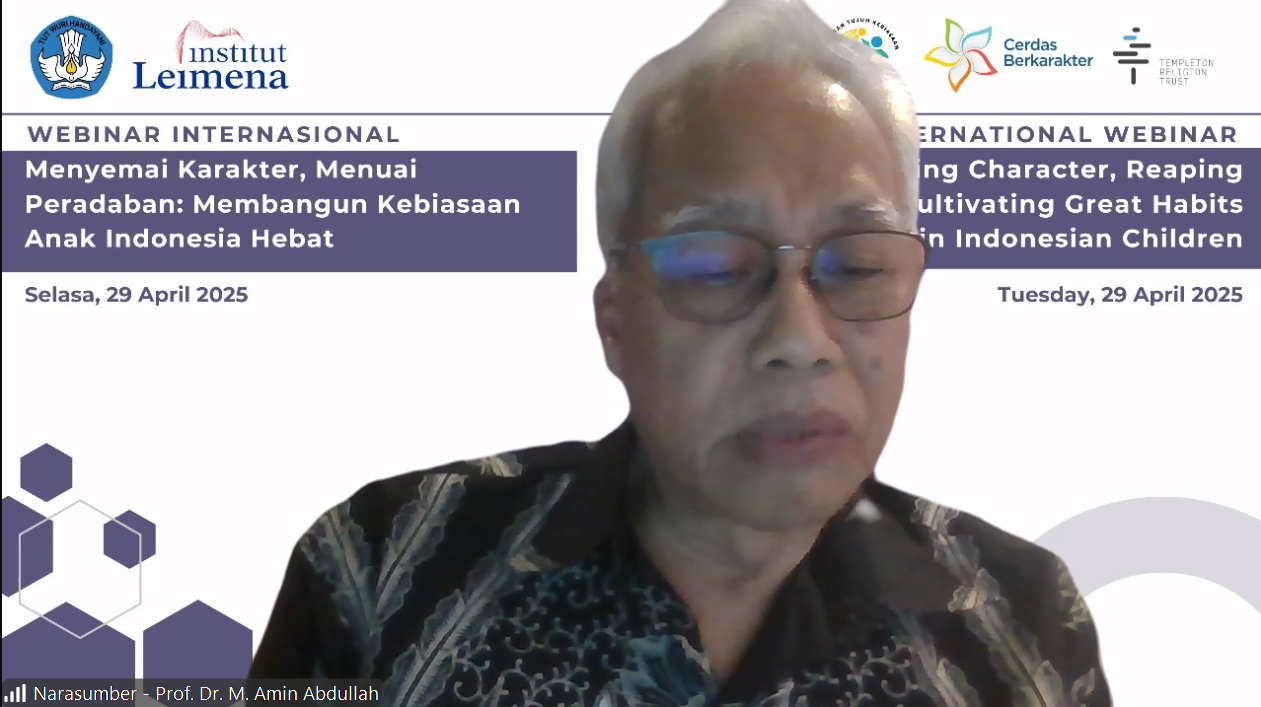
Senior Fellow of the Leimena Institute and Member of the Steering Committee of the Pancasila Ideology Development Agency (BPIP), Prof. Dr. Amin Abdullah
Echoing this, Senior Fellow of the Leimena Institute and Member of the Steering Committee of the Pancasila Ideology Development Agency (BPIP), Prof. Amin Abdullah, underlined the importance of integrating Cross-Cultural Religious Literacy (CCRL) with the 7 KAIH. The CCRL program, initiated by the Leimena Institute, aims to enhance teachers’ competence in engaging within a plural society. To date, the CCRL program has trained more than 9,600 teachers from 38 provinces across Indonesia.
“Character building has tremendous implications for nation building. If the state of the nation is not well, it is a reflection of the character of its individuals,” Amin said.
Amin pointed out two of the 7 KAIH habits that can be strengthened through the CCRL program: worshiping and engaging in society. He explained that the CCRL program teaches three core competencies to teachers: first, how teachers can deepen their understanding of their own religion (personal competence); second, how they can show empathy to those of different religions and beliefs (comparative competence); and finally, how they can collaborate for the common good (collaborative competence).
“Worship—to love God—is important, but it must intersect with engaging in society. The combination of CCRL and the habits of great Indonesian children will form a generation of excellent character: strong in faith, open-minded, and acting with empathy,” Amin said.
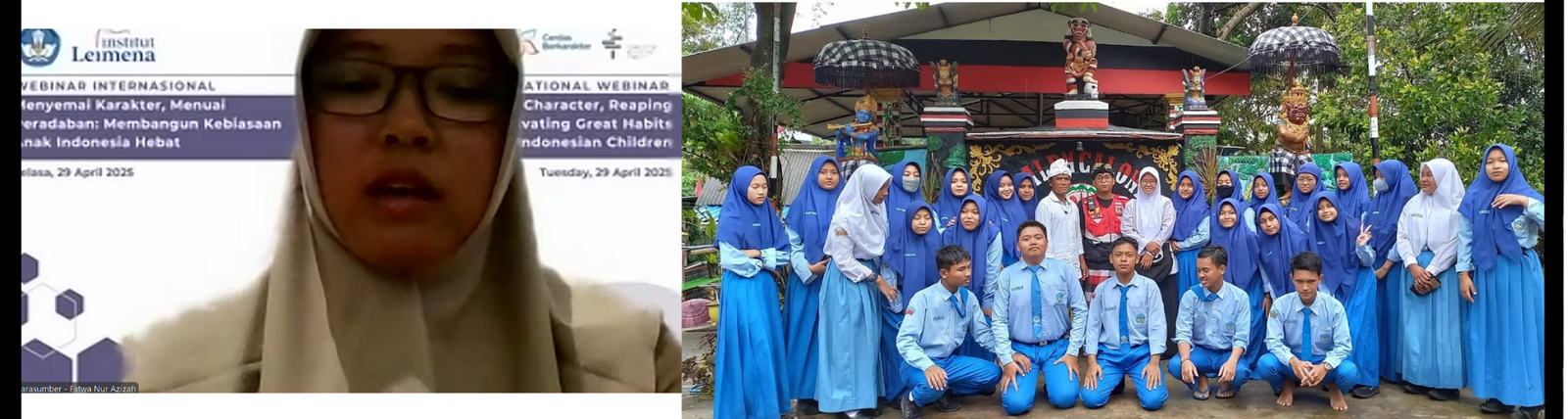
Fatwa Nur Azizah, Qur’an-Hadith Teacher at MAN 1 Magetan, East Java, sharing her experience in teaching tolerance to students through visits to houses of worship of other religions
Experience of a CCRL Alumni Teacher
Fatwa Nur Azizah, a Qur’an-Hadith teacher at Madrasah Aliyah Negeri (MAN) 1 Magetan, East Java, and also an alumna of the 5th cohort of the CCRL program, shared her good practice in strengthening her students’ habit of engaging in society, especially with those of different religions.
Fatwa invited her students at MAN 1 Magetan to visit and clean the surroundings of a Hindu temple (pura). She carried out this activity in response to her concern that the values of tolerance often taught in schools remained only at the level of theory.
“Sometimes we teach the values of tolerance, but we don’t teach how to practice tolerance in everyday life,” she said.
Fatwa aimed to create an open space for dialogue where students could communicate, confirm, and cultivate empathy towards people from different religious backgrounds. According to her, the CCRL program had enlightened her and other teachers on how to conduct interreligious collaboration.
Fatwa stressed that prejudice against those of different religions can hinder relationships in community life. Therefore, direct encounters and dialogue can effectively reduce such prejudice.
“A student once came to me and said, ‘Thank you, ma’am, I had never learned things like this before.’ At that moment I felt deeply moved and almost cried, realizing that what I did left an impression in my students’ hearts,” Fatwa said.
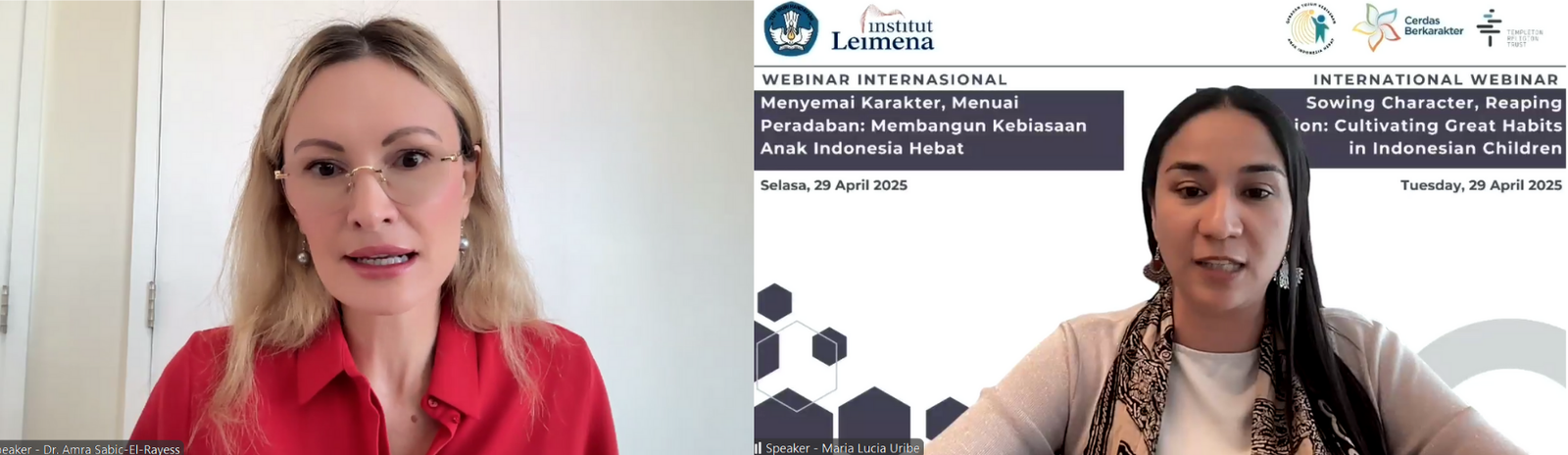
Dr. Amra Sabic-El-Rayess, Executive Director of the International Interfaith Research Lab, Teachers College, Columbia University, USA (left), and Maria Lucia Uribe, Executive Director, Arigatou International, Switzerland (right)
A Pedagogy that Unites
Similarly, Maria Lucia Uribe, Executive Director of Arigatou International, Switzerland, emphasized the urgency of an educational approach that not only teaches, but also shapes whole human beings and fosters reflective thinking.
According to her, 21st century education must be more than a transfer of knowledge; it must become a systematic life experience and a pedagogy that nurtures intercultural dialogue, encourages critical thinking, and strengthens mutual respect.
“We live in an era of high connectivity, yet we witness growing bias, fear of differences, and social fragmentation. Schools should serve as meeting spaces that unite, not divide,” Maria explained.
Dr. Amra Sabic-El-Rayess, Executive Director of the International Interfaith Research Lab at Teachers College, Columbia University, USA, explained the concept of educational displacement—alienation within educational spaces or facilities—that may occur if schools fail to nurture education that upholds humanitarian values.
“My own experience as a Bosnian Muslim in the 1990s shows how genocide was not the beginning of violence, but the culmination of narratives perpetuated for years, across generations, that excluded others—whoever they might be—based on geography or mass identity,” Amra said.
Amra underlined the importance of educational narratives that cultivate empathy and stories that inspire love for fellow human beings. Curricula must be able to represent humanitarian values without barriers