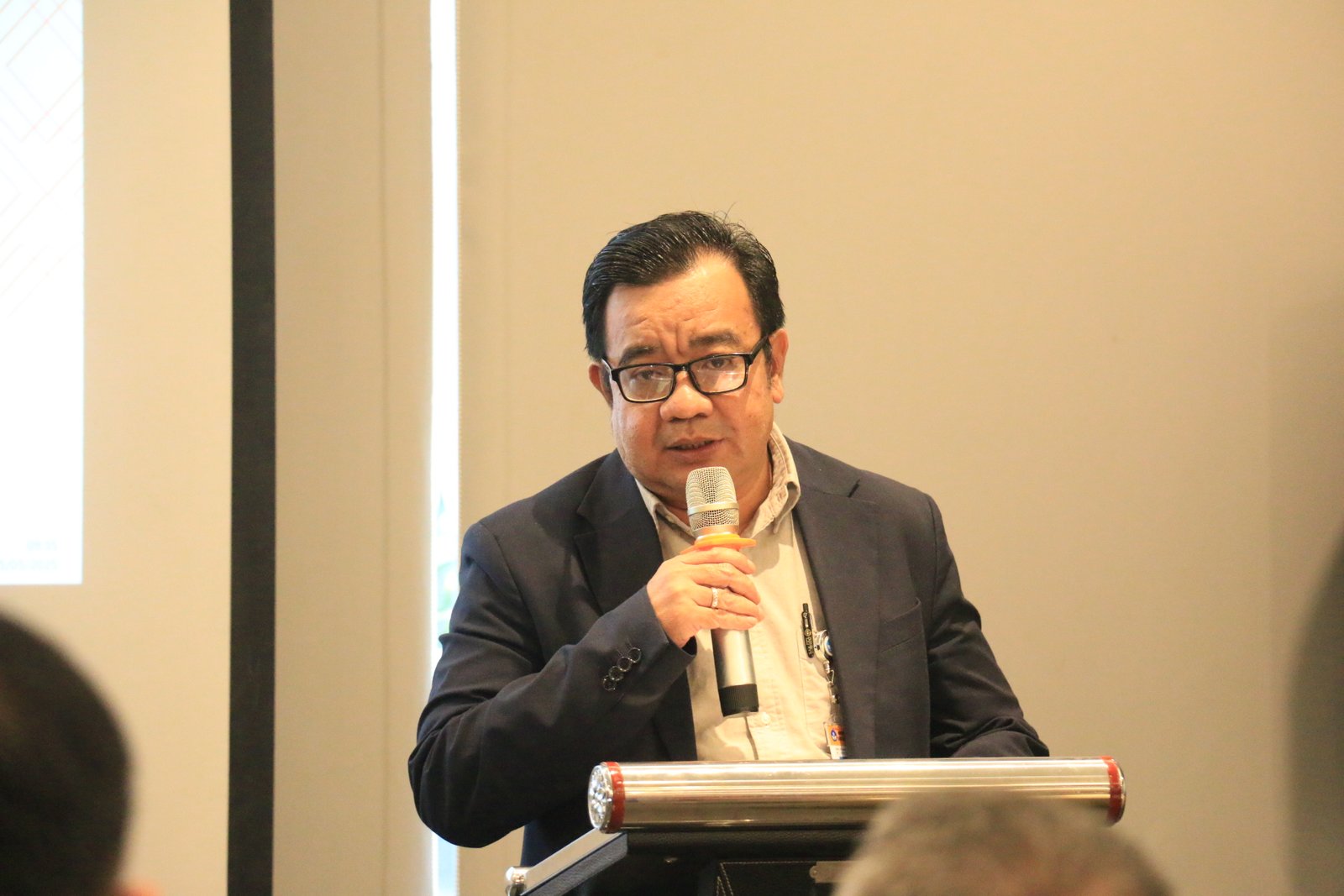
Special Staff to the Minister of Primary and Secondary Education, Arif Jamali Muis, during Panel Discussion I: Insertion of the Curriculum of Love, 7 Habits of Great Indonesian Children, and Deep Learning with the Cross-Cultural Religious Literacy Approach in Jakarta, Thursday, May 15, 2025.
Jakarta, LKLB News – In line with the implementation of the 7 Habits of Great Indonesian Children (7 KAIH) and deep learning by Indonesia’s Ministry of Primary and Secondary Education (Kemendikdasmen), schools can broadly implement Cross-Cultural Religious Literacy (CCRL) not only through intracurricular activities such as modules and lesson plans (RPP), but also by involving co-curricular activities that support the formal classroom learning process.
This was conveyed by Special Staff to the Minister of Primary and Secondary Education, Arif Jamali Muis, during Panel Discussion I: Insertion of the Curriculum of Love, 7 Habits of Great Indonesian Children, and Deep Learning with the Cross-Cultural Religious Literacy Approach, held in Jakarta, Thursday, May 15, 2025.
“It seems that what has so far been touched by the Leimena Institute is the intracurricular aspect, such as integrating CCRL into lesson plans or teaching modules. The integration of intracurricular and co-curricular will bring CCRL deeper into children’s understanding, aligning with the deep learning approach,” said Arif.
Intracurricular refers to formal learning activities in the classroom, while co-curricular refers to additional activities outside school hours that are still related to the learning material but are carried out in more practical and applicative ways.
Arif said that the insertion of CCRL into classroom learning (intracurricular), which has been carried out by teachers and schools, must be maintained. However, there is also a greater opportunity to implement CCRL through co-curricular activities.
“CCRL can be integrated with the 7 Habits of Great Indonesian Children, particularly in the habits of worship and social engagement. These two habits are closely related to the competencies of CCRL, namely personal, comparative, and collaborative,” he said.
Drawing on his experience as a deputy head of school for curriculum, Arif shared that he was often asked to include certain aspects into learning. For example, the Corruption Eradication Commission (KPK) encouraged the integration of anti-corruption education into the curriculum, while the Environmental Office emphasized Adiwiyata (eco-school) aspects.
For this reason, he is optimistic that integrating CCRL into both intracurricular and co-curricular aspects of learning will touch students’ conscience more profoundly.
“The integration of CCRL into co-curricular activities is important because its implementation involves teachers across multiple subjects. For example, when a school develops a project on social concern, teachers of subjects such as Islamic Religious Education (PAI), Social Studies (IPS), and Language will interconnect with each other, making the learning far more meaningful for students,” Arif explained.

Teachers and principals from various regions in Indonesia, including Java, Sulawesi, and Maluku, attended the panel discussion organized by the Leimena Institute to design CCRL-based curriculum and learning.
The Habit of Tolerance
Arif also enriched his presentation by sharing personal experiences in teaching tolerance. “I believe that tolerance is the result of the habit of interacting with people who are different,” said Arif.
He shared that when his child was about to continue to junior high school, they deliberately did not choose a large school. “This is because my child wanted to have friends of different religions,” said Arif, who supported the decision.
At one point, Arif asked his child how it felt to have friends of different faiths. His child responded that it was nothing unusual, not a problem at all. “My child considered it normal, even something they could joke about, because they were already used to being with those who were different,” he said.
For Arif, this experience shows that teaching tolerance, including through CCRL, is not sufficient if only through theory in the classroom. Habits of interaction and dialogue with those who are different need to be instilled in the process of shaping children’s character.
In line with this, Analyst from the Center for Character Strengthening, Ministry of Primary and Secondary Education, Dr. Kosasih Ali Abu Bakar, emphasized the urgency of character formation through habituation. Kosasih noted the many challenges faced today, including the “strawberry generation,” the “nocturnal generation” (referring to the habit of staying up late at night and waking up late in the day), pornography, and online gambling that ensnares nearly a million students. That is why the 7 KAIH program is aimed at cultivating positive habits among students from an early age.
“Habits will give birth to routines, routines form character, and character nurtures civilization,” said Kosasih.