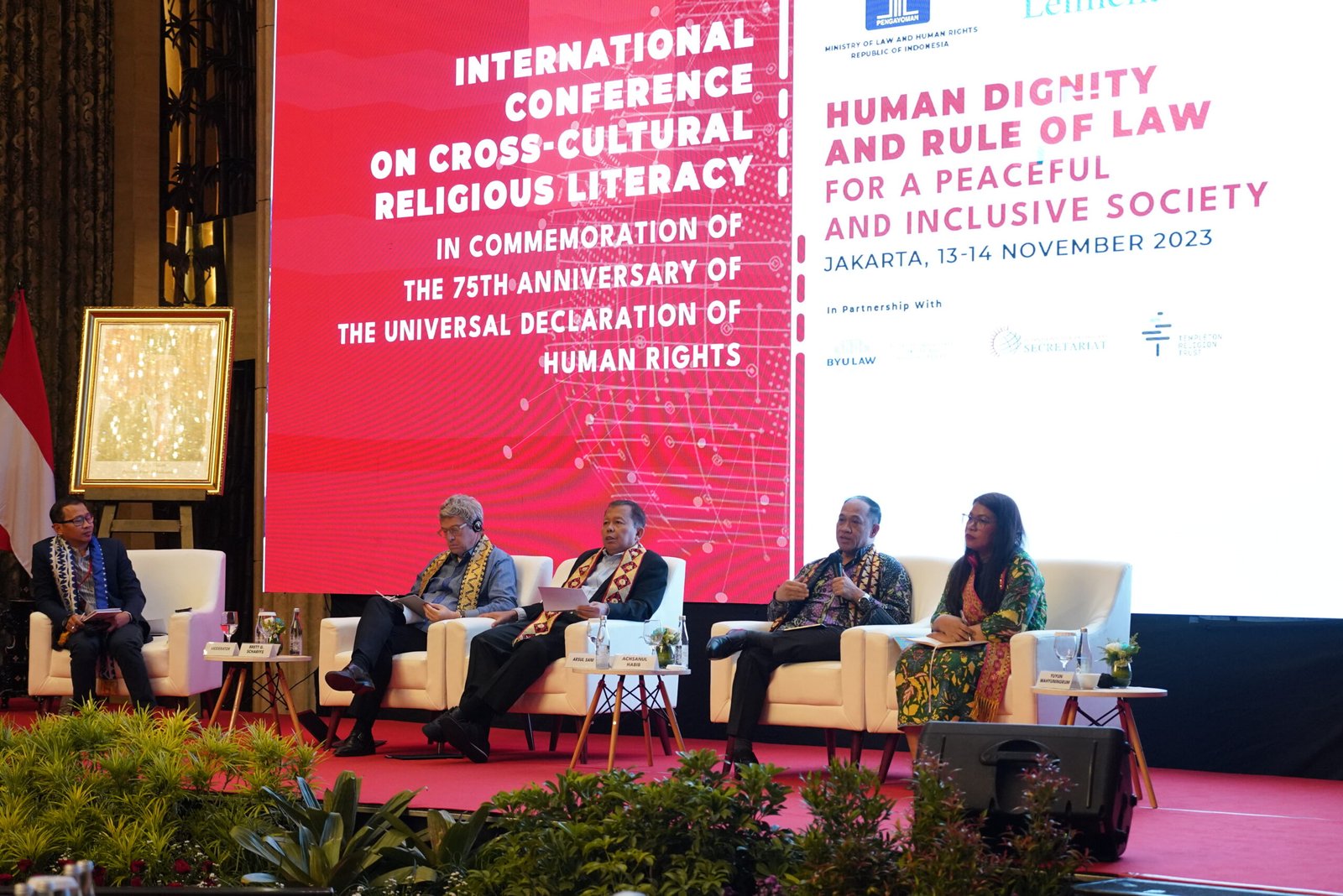
Panel Session 1 speakers of the International Conference on Cross-Cultural Religious Literacy with the theme “Human Dignity and Rule of Law: Global and Regional Outlook”, at Kempinski Hotel, Jakarta, 13 November 2023.
Jakarta, LKLB News – Indonesia encourages that discussions on the human rights (HAM) agenda at the international level be carried out in a constructive spirit. It is recognized that there are currently several challenges in the United Nations (UN) Human Rights Commission that may become obstacles to the implementation of human rights.
“Countries need to regain the space to discuss human rights with a constructive and open spirit under the influence of geopolitics, bearing in mind that no one is perfect,” said the Deputy Permanent Representative of the Republic of Indonesia to the United Nations, the World Trade Organization (WTO), and other international organizations in Geneva, Switzerland, Achsanul Habib, in Panel Session 1 of the International Conference on Cross-Cultural Religious Literacy (CCRL) at Kempinski Hotel, Jakarta, 13 November 2023.
Ambassador Habib was one of the speakers in Panel Session 1 of the International LKLB Conference with the theme “Human Dignity and Rule of Law: Global and Regional Outlook” together with the Vice Head of the People’s Consultative Assembly (MPR) of the Republic of Indonesia, Arsul Sani, Indonesia’s Representative to the ASEAN Intergovernmental Commission on Human Rights (AICHR), Yuyun Wahyuningrum, and the Director of the International Center for Law and Religion Studies at Brigham Young University, Brett Scharffs.
Ambassador Habib said there are several challenges in the Human Rights Council, among them the difficulty in reaching consensus, especially when it involves attention to country-specific resolutions and thematic issues. As a result, there is no consensus because decisions must be taken by voting.
The second challenge is that often issues raised on the agenda of the Human Rights Council only concern the interests of one side or one party, not common interests. Meanwhile, the third challenge is how to interpret freedom of expression from certain countries that are quite dominant in human rights.
“Recognizing these challenges, this is indeed the spirit we must develop. Let us carry out human rights for the purpose of human rights, not human rights as a tool for political purposes or political interests,” stressed Habib.
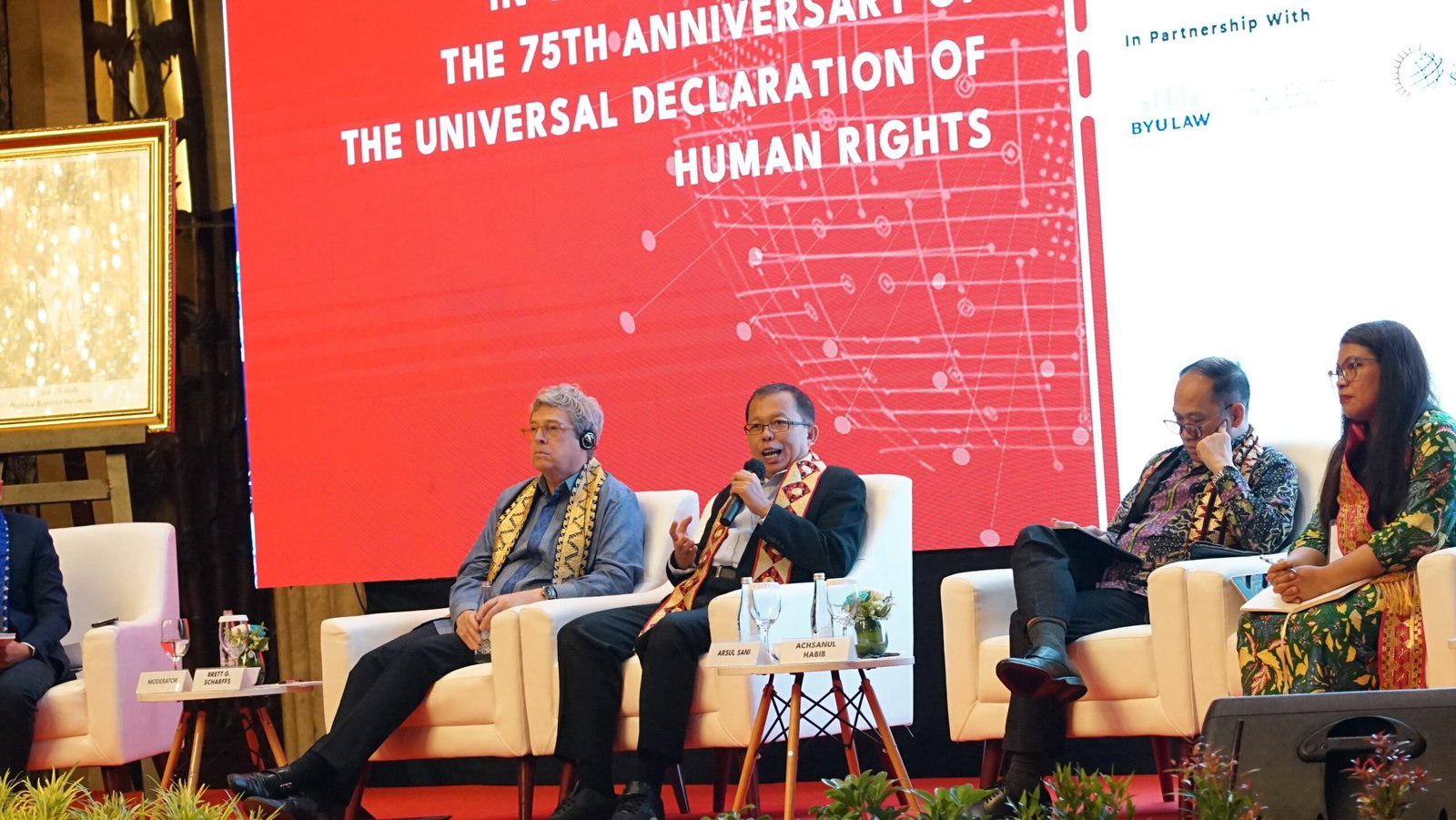
Vice Head of the People’s Consultative Assembly of the Republic of Indonesia, Arsul Sani, delivering his presentation.
Ambassador Habib added that International Human Rights Day is commemorated every December 10, in line with the adoption of the Universal Declaration of Human Rights (UDHR) on 10 December 1948. Based on the UDHR, continued Achsanul, the UN established the Human Rights Council in 2006 to replace the Human Rights Commission.
With the establishment of the UN Human Rights Council, countries around the world expect further efforts to carry out monitoring of the advancement of human rights, advocacy to provide understanding of human rights, and capacity building to help countries implement human rights values.
Meanwhile, Arsul Sani explained that human dignity and human rights in Indonesia are already enshrined in the 1945 Constitution as the highest basic constitution and Pancasila as the foundation of the state.
“Specifically, Indonesia has balanced the implementation of human dignity and human rights as constitutional rights. Our constitution also includes the obligation to respect the rights of other citizens when those citizens exercise their rights,” said Arsul.
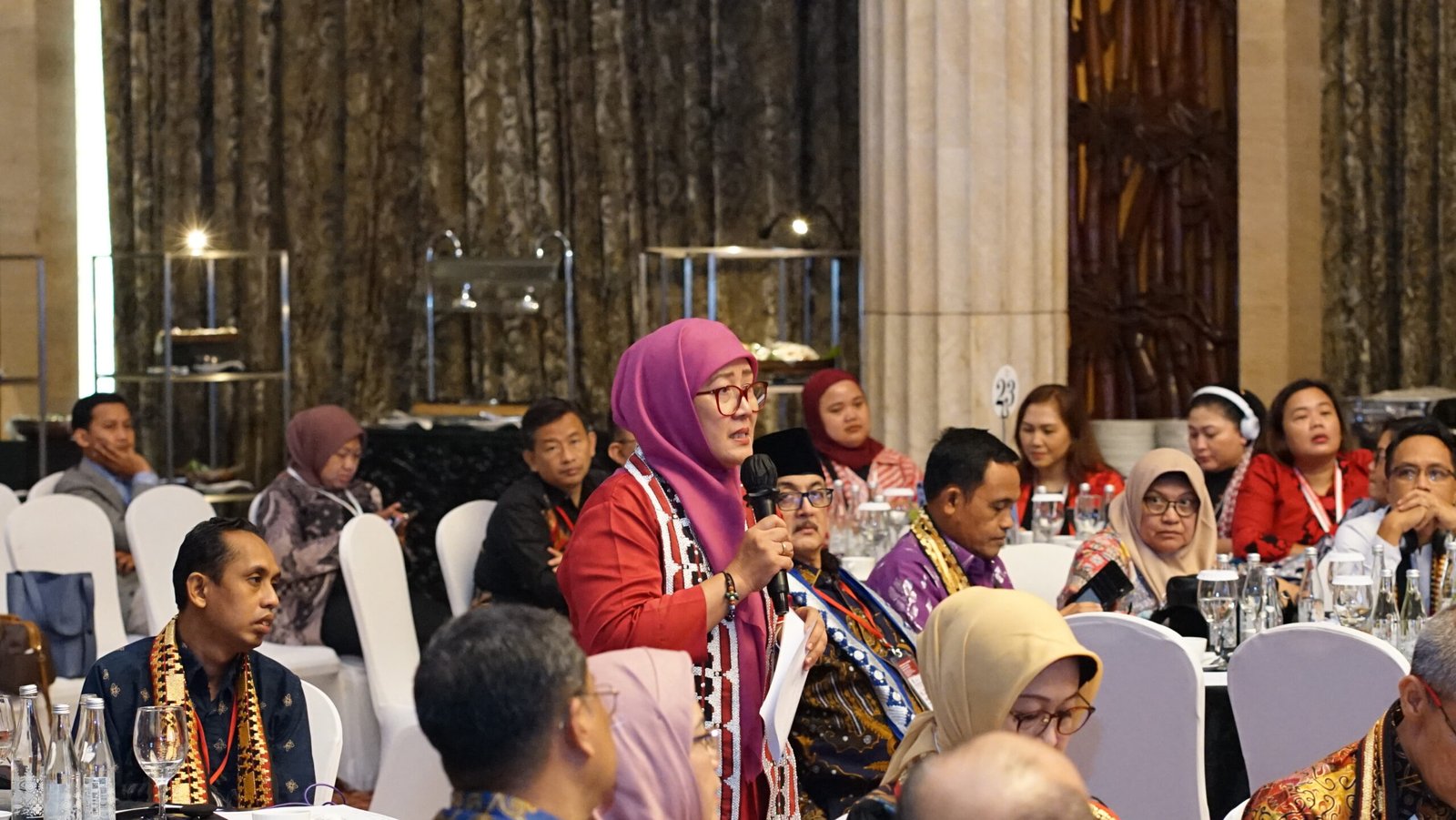
Conference participants were able to ask questions interactively in each session.
The Human Rights Ecosystem in ASEAN
Yuyun Wahyuningrum added that the rule of law is a vehicle for promoting the protection of human rights so that it can work to build a dignified, peaceful, and prosperous life.
“We can use the rule of law to enhance the advancement and protection of human rights. We need a human rights ecosystem in ASEAN. This ecosystem includes strengthening the rule of law,” said Yuyun Wahyuningrum.
Meanwhile, Brett Scharffs shared seven ideas on how human dignity can help individuals or communities when in times of conflict. First, however difficult it may be, society must resist the temptation to dehumanize one another or to avoid dehumanization of the enemy.
Second, avoiding blaming groups for crimes committed by individuals or certain persons belonging to those groups. Third, reducing thinking in terms of us versus them.
“We need to take a step back and remember that we are all us and we are all them. We are all human beings,” said Scharffs.
The fourth idea, eliminating the tendency to see very clearly the mistakes committed by the enemy which will provoke society to mobilize its own actions against that enemy. For the fifth idea, it relates to the rules contained in the Geneva Conventions, namely the rules that regulate how to behave during conflict so as not to harm civilians.
“Sixth, to get to know and understand one another. Not only seeing humans as distant targets but as human beings trying to understand each other so that war or humanitarian tragedy does not occur. Seventh, human dignity must acknowledge that each of us has the right to live well, both as individuals and as human beings,” explained Scharffs.