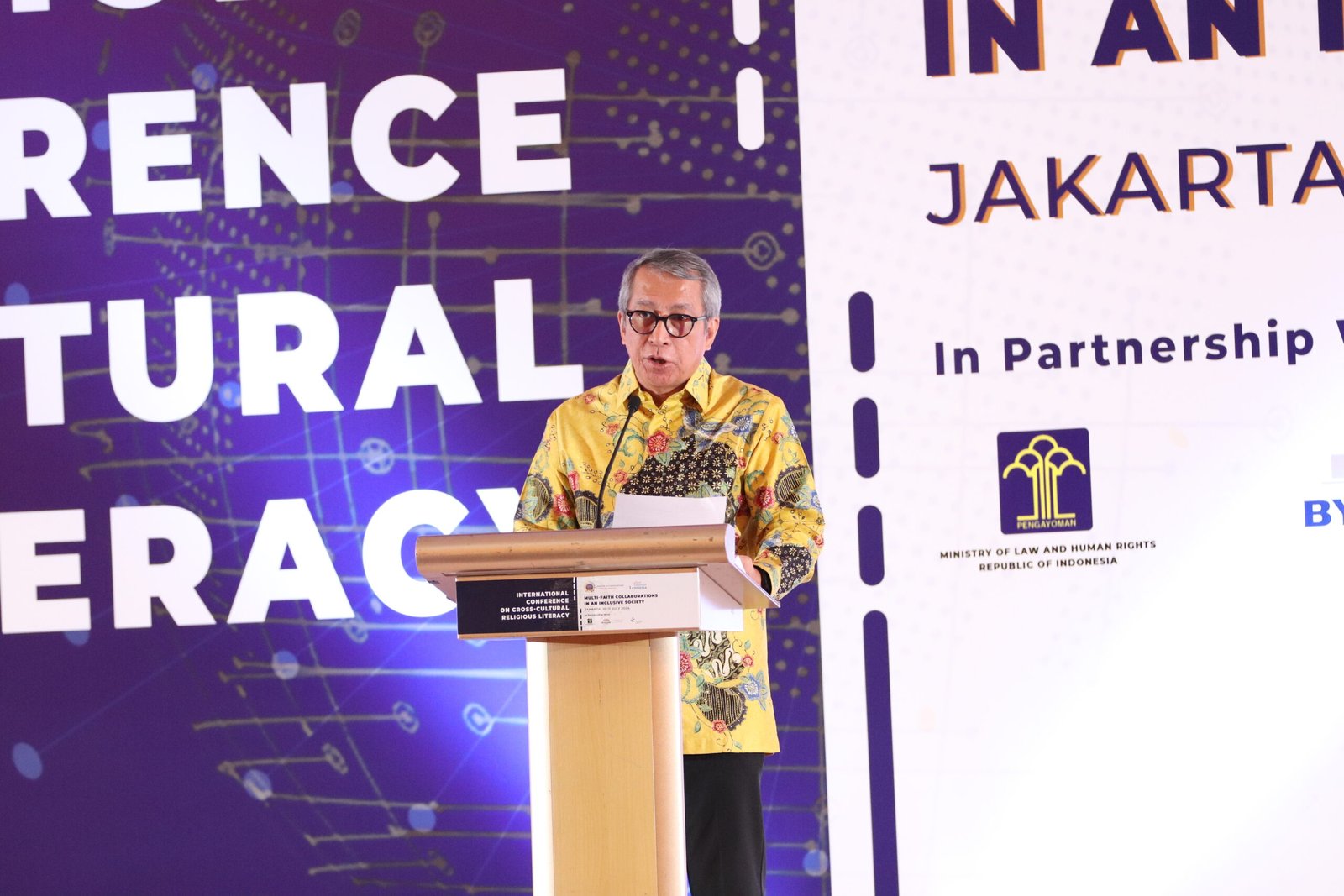
The Ministerial Special Staff of the Foreign Minister for Strengthening Priority Programs, Ambassador Dian Triansyah Djani, delivered the closing remarks at the International Conference on Cross-Cultural Religious Literacy (ICCRL), July 11, 2024.
Jakarta, LKLB News – Indonesia has become a global example in building peace and harmony within a very diverse nation. Such efforts cannot be taken lightly but must be continually nurtured by strengthening understanding of Cross-Cultural Religious Literacy and multi-faith collaboration within society.
This was conveyed by the Ministerial Special Staff of the Foreign Minister for Strengthening Priority Programs, Ambassador Dian Triansyah Djani, during the closing session of the International Conference on Cross-Cultural Religious Literacy (CCRL) organized by the Ministry of Foreign Affairs of the Republic of Indonesia and the Leimena Institute on July 11, 2024.
Dian shared Indonesia’s experiences in building multi-faith collaboration before about 160 conference participants from home and abroad, consisting of officials from foreign government institutions, international organization leaders, religious leaders, and teachers.
“Indonesia, with its religious and cultural diversity, stands as a real example of a nation where religious and ethnic communities can live side by side in peace and harmony. This cannot be taken for granted—our national unity and social cohesion must always be maintained through fostering Cross-Cultural Religious Literacy and multi-faith collaboration within society,” said Dian.
Dian reminded the audience that today’s global situation is marked by armed conflicts, polarized politics, and multifaceted crises that threaten humanity. These crises are often worsened by the misuse of new digital technologies, biased and negative intelligence, stigmatization, and deepening divisions in society.
“Promoting Cross-Cultural Religious Literacy and multi-faith collaboration is essential to create and nurture tolerant and peaceful societies, where values of compassion, empathy, and mutual respect are shared and guide the lives of their members,” he said.
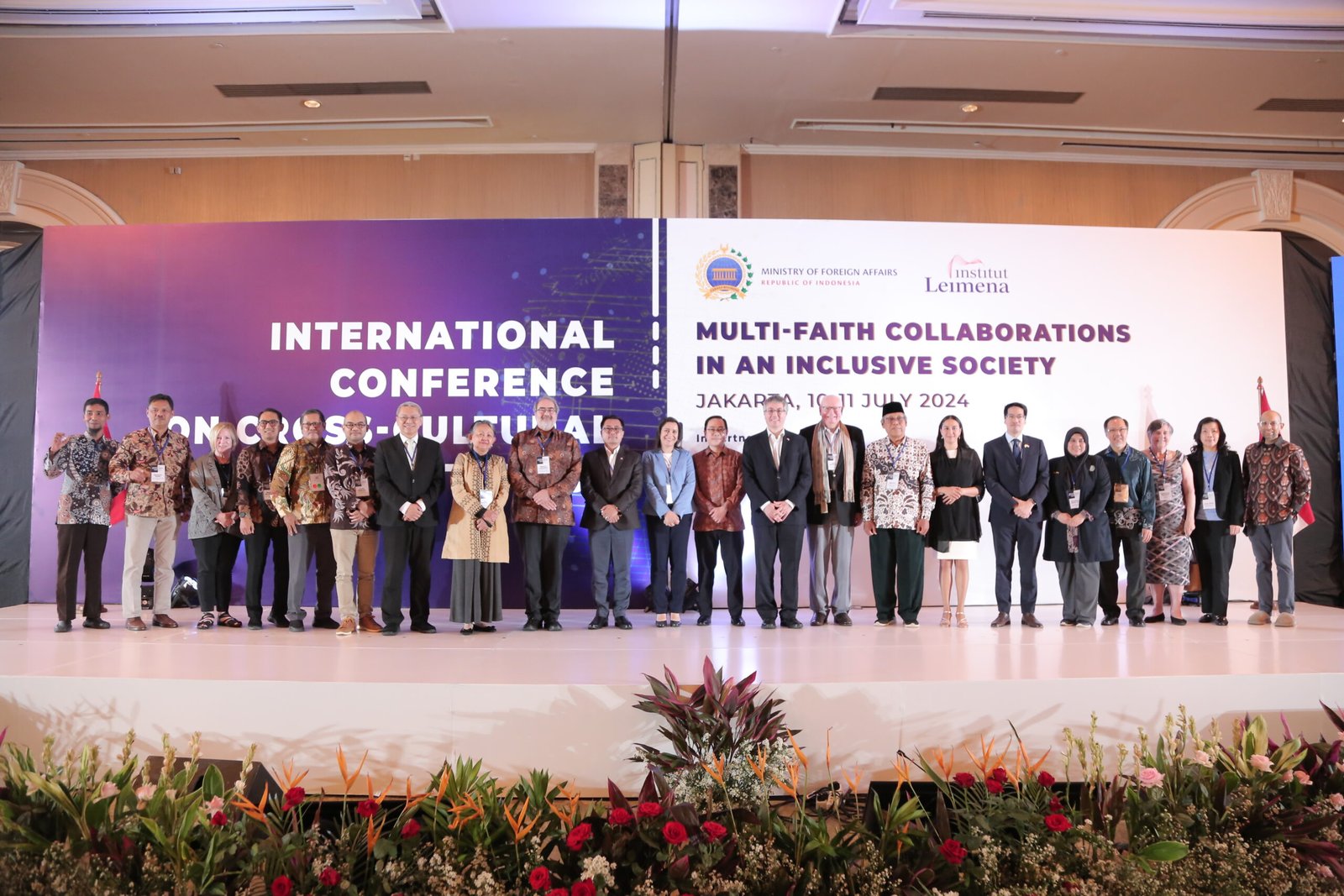
Speakers at ICCRL 2024 included government officials, academics, and international organization leaders from both Indonesia and abroad.
Dian emphasized that efforts to promote religious tolerance have been one of Indonesia’s main priorities during its membership on the United Nations Human Rights Council. As a member of the Organization of Islamic Cooperation (OIC), Indonesia initiated two important resolutions: Resolution 16/18 on combating religious intolerance and violence, and Resolution 53/1 on combating religious hatred. Both political documents stress the protection of freedom of religion and belief as a fundamental human right.
More importantly, Resolution 16/18 promotes education and dialogue among individuals of different religions and beliefs. In addition, Indonesia’s strong commitment to multi-faith collaboration was demonstrated through the Jakarta Plurilateral Dialogue in 2023, which aimed to mainstream Resolution 16/18.
“This means Indonesia is not only promoting but also practicing multi-faith collaboration in our diplomacy. Through this collaboration, we send an important message to the world about the valuable contribution of interfaith cooperation in realizing human rights, peace, and development,” Dian continued.
The International Conference on CCRL was held over two days, July 10–11, 2024, opened by the Indonesian Foreign Minister Retno Marsudi, and attended by representatives from 22 foreign countries, including six ambassadors: Austrian Ambassador to Indonesia Thomas Loidl; Jordanian Ambassador to Indonesia and ASEAN Sudqi Atallah Abd Alkader Al Omoush; Romanian Ambassador Dan Adrian Balanescu; Spanish Ambassador Francisco Aguilera Aranda; UAE Ambassador Abdulla Salem Al Dhaheri; and the Holy See’s Apostolic Nuncio to Indonesia, Archbishop Piero Pioppo.
The conference also featured prominent foreign speakers engaged in advancing interfaith cooperation, including: Founding Director of the International Center for Law and Religion Studies at Brigham Young University Law School, Dr. Cole Durham; Head of Task Force “Dialogue of Cultures” for Intercultural and Interreligious Dialogue at the Federal Ministry of European and International Affairs of Austria, Alexander Rieger; Executive Director of the World Faiths Development Dialogue, Dr. Katherine Marshall; Director of the Royal Institute for Inter-Faith Studies, Jordan, Dr. Renee Hattar; and Secretary General of the Higher Committee of Human Fraternity, United Arab Emirates, Khalid Al Ghaith.