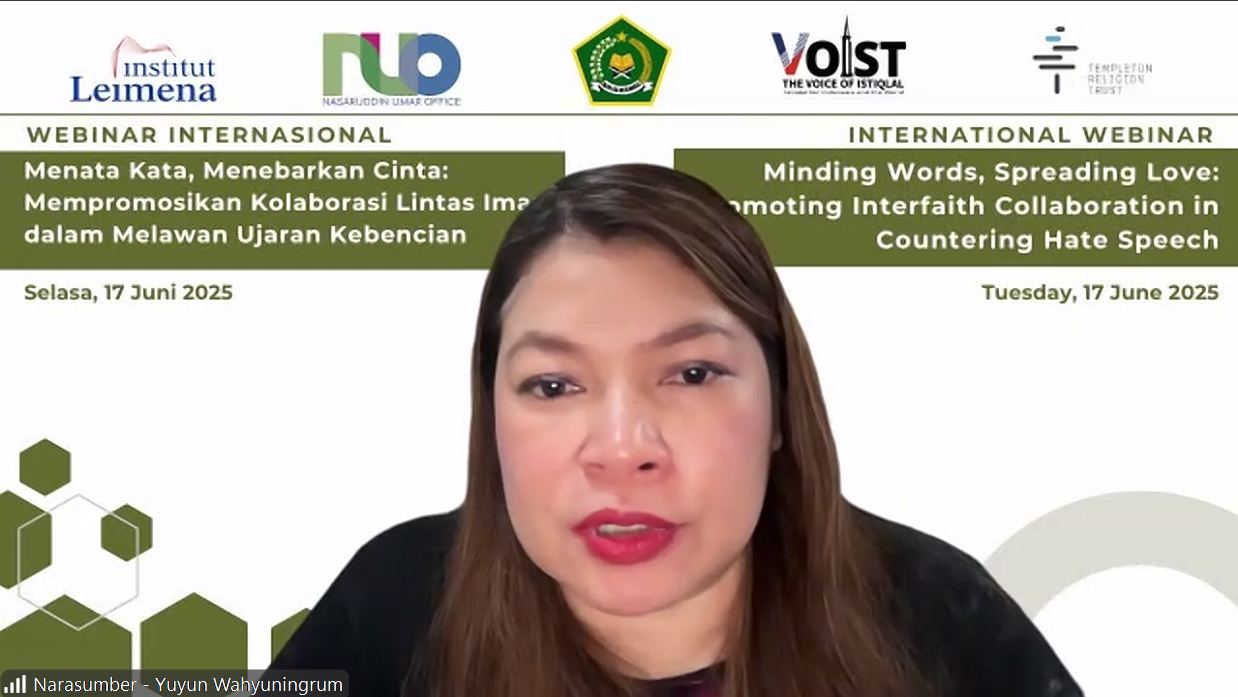
Executive Director of ASEAN Parliamentarians for Human Rights (APHR), Yuyun Wahyuningrum, speaking at the International Webinar held to commemorate the International Day Against Hate Speech, organized by the Indonesian Ministry of Religious Affairs, Leimena Institute, Voice of Istiqlal, and the Nasaruddin Umar Office, Tuesday evening, June 17, 2025.
Jakarta, LKLB News – Efforts to build a safe digital ecosystem are becoming increasingly important to maintain social harmony in a pluralistic society that is easily polarized. Executive Director of ASEAN Parliamentarians for Human Rights (APHR), Yuyun Wahyuningrum, expressed concern over the current state of the digital space, which, on the one hand, has successfully connected people across borders, but on the other hand, has been flooded with hate, disinformation, and even fertile ground for the spread of hoaxes and hate speech.
“Hate speech is no longer something minor. It now floods our timelines, targeting people for who they are, what they believe, and who they love,” Yuyun said at the International Webinar Series on Cross-Cultural Religious Literacy (CCRL) themed “Shaping Words, Spreading Love: Promoting Interfaith Collaboration in Countering Hate Speech”, June 17, 2025.
Yuyun urged several solutions, one of which focuses on the central role of parliaments that hold significant power. She emphasized that parliaments do not only work to draft and pass laws, but also to shape public discourse, allocate resources, and hold institutions accountable.
“What we are facing is not only a crisis of harmful content. It is also a crisis of governance, ethics, and political will,” Yuyun stressed.
She highlighted the discontinuity of roles between digital platform managers as algorithm organizers, governments as policy makers and implementers, and society as users. This is what she referred to as the triple disconnect. Such disconnection, she warned, would make democracy increasingly vulnerable.
Therefore, Yuyun outlined at least five concrete steps that parliamentarians can take. First, formulate human rights–based legislation to prevent incitement to hatred without silencing freedom of expression. Second, monitor the implementation of laws to ensure they are not misused to silence criticism.
Third, fund media literacy and independent journalism to encourage citizens to think critically. Fourth, build inclusive platforms to involve civil society, technology companies, and educators in formulating national action plans.
“Fifth, parliamentarians must become moral role models by courageously rejecting hate speech, even when it comes from their own parties or supporters,” Yuyun said.
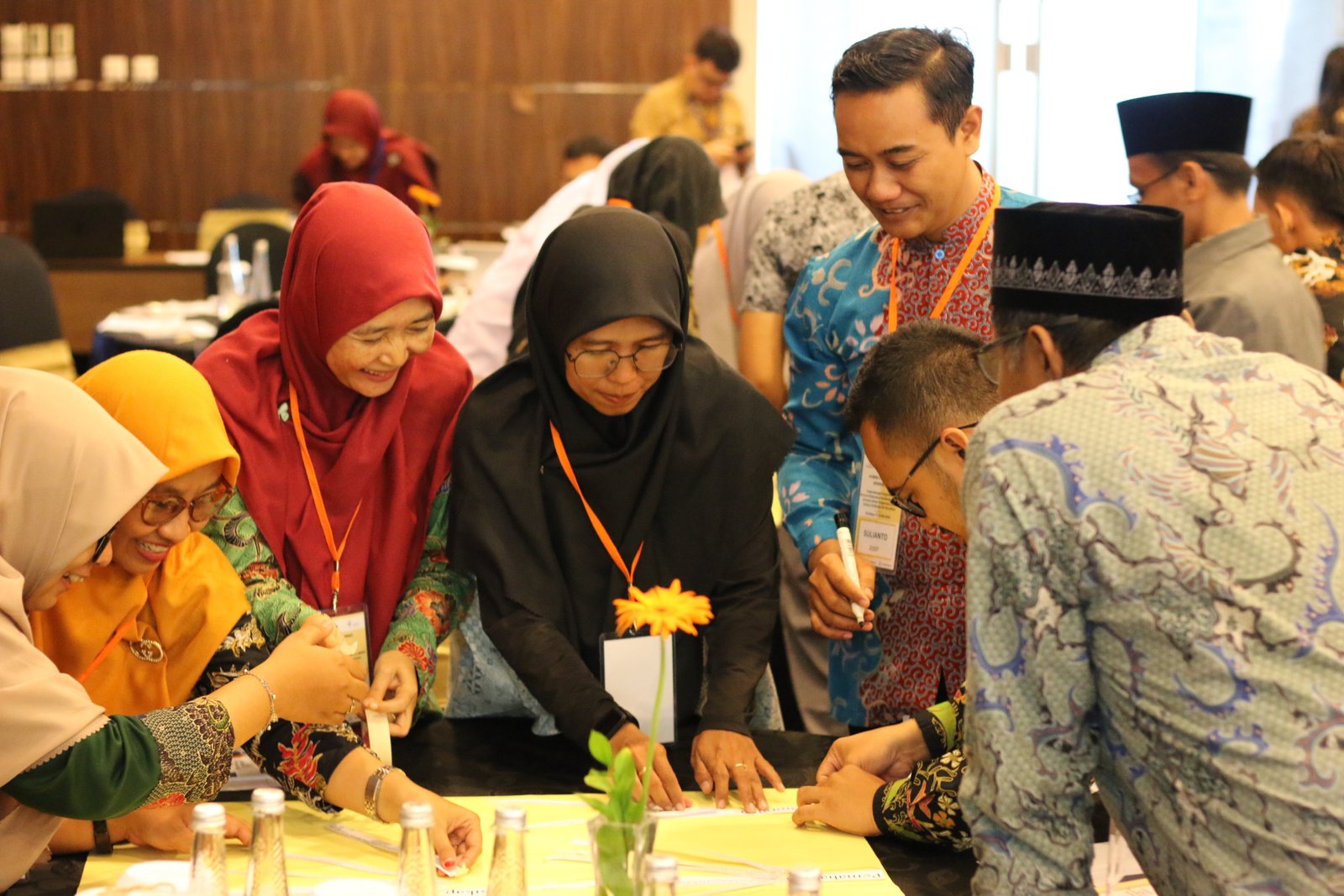
Teachers participating in a Cross-Cultural Religious Literacy workshop to strengthen understanding of freedom of religion and human rights. Efforts to counter hate speech require support from all stakeholders, including teachers and educators.
Yuyun emphasized that hate speech is not merely a technological issue, but a human rights and democracy issue. According to her, hatred in cyberspace is not virtual or confined to screens. Hatred turns into threats, attacks, silencing, and at times, violence. She cited how social media posts contributed to violence against the Rohingya in Myanmar. In countries such as Indonesia, Thailand, and the Philippines, disinformation peaked during elections, scapegoating minorities and women politicians.
She added that international law, including the International Covenant on Civil and Political Rights, is clear that states must prohibit incitement to discrimination, hostility, or violence. However, across ASEAN, two problems persist: first, some governments misuse hate speech laws to silence dissent or criminalize criticism. Second, where regulation is needed, it is often absent.
“Technology companies, which are based far from our region, do not always understand local contexts. Their moderation systems struggle to comprehend our languages, histories, and politics,” Yuyun said.
She noted that parliaments also need support from all stakeholders — journalists, educators, religious leaders, and every citizen — to safeguard the digital ecosystem. Community-based efforts, such as those in Indonesia, should also be expanded, including promoting curricula based on love and tolerance, interfaith dialogue, and educational campaigns.
“Hatred is now increasingly hidden in memes, sarcasm, and coded language. Therefore, the tools and policies developed by governments must also evolve,” Yuyun said.