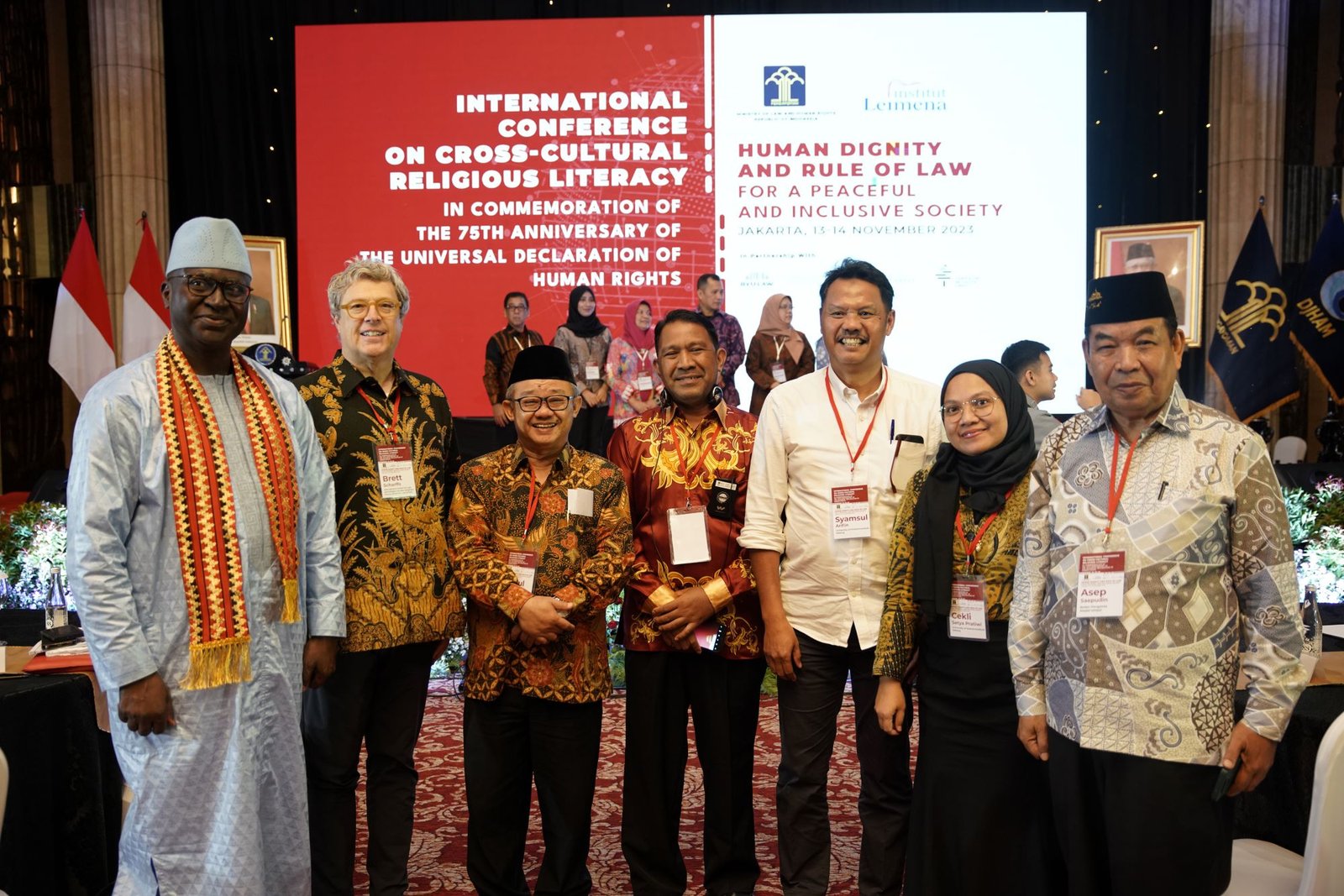
Secretary General of Muhammadiyah Central Board, Prof. Dr. Abdul Mu’ti (third from left), together with Vice President of the United Nations Human Rights Commission, Muhammadou M.O. Kah, and Director of the International Center for Law and Religion Studies, Brigham Young University, Brett Scharffs, as well as several participants of the International Conference on Cross-Cultural Religious Literacy at Kempinski Hotel, Jakarta, November 14, 2023.
Jakarta, LKLB News – Faith-based organizations must always uphold universal human values in building relations with different religious groups. This effort is crucial to ensure respect for human rights and human dignity in a pluralistic society.
“When we talk about crossing the border, it requires a bridge that enables us to meet and interact with different religious groups, both in terms of religion and culture,” said the Secretary General of Muhammadiyah Central Board, Prof. Dr. Abdul Mu’ti, in Panel 5 of the Cross-Cultural Religious Literacy Conference held at Kempinski Hotel, Jakarta, November 14, 2023.
Abdul Mu’ti emphasized that cross-cultural religious literacy can be carried out to foster the involvement of religious organizations in upholding human dignity. For this reason, religious groups need the courage to cross the boundaries or walls that have long separated and limited the involvement of religion and culture.
According to him, there are two bridges that enable these faith-based organizations to cross their boundaries. The first is universal values, which include the values of humanity, life, happiness, and freedom. These allow faith-based organizations to have empathy and sympathy for fellow human beings, including the concern to extend a hand and provide assistance to those in need, even if they are not from the same group.
“The second bridge is responsibility, including the responsibility to preserve nature, to build peace, and to foster life in mutual respect and peaceful coexistence despite differences in religion, belief, and culture,” said Abdul Mu’ti.
In walking these two bridges, he continued, the challenge to be faced is how to maintain an open attitude toward differences. For this, faith-based organizations or religious groups must build two important things.
“First, we need to build inclusive relations and spaces. We need to create more spaces where we can meet one another. Spaces where we can speak freely to each other, spaces where we can breathe the same air together,” said Abdul Mu’ti.
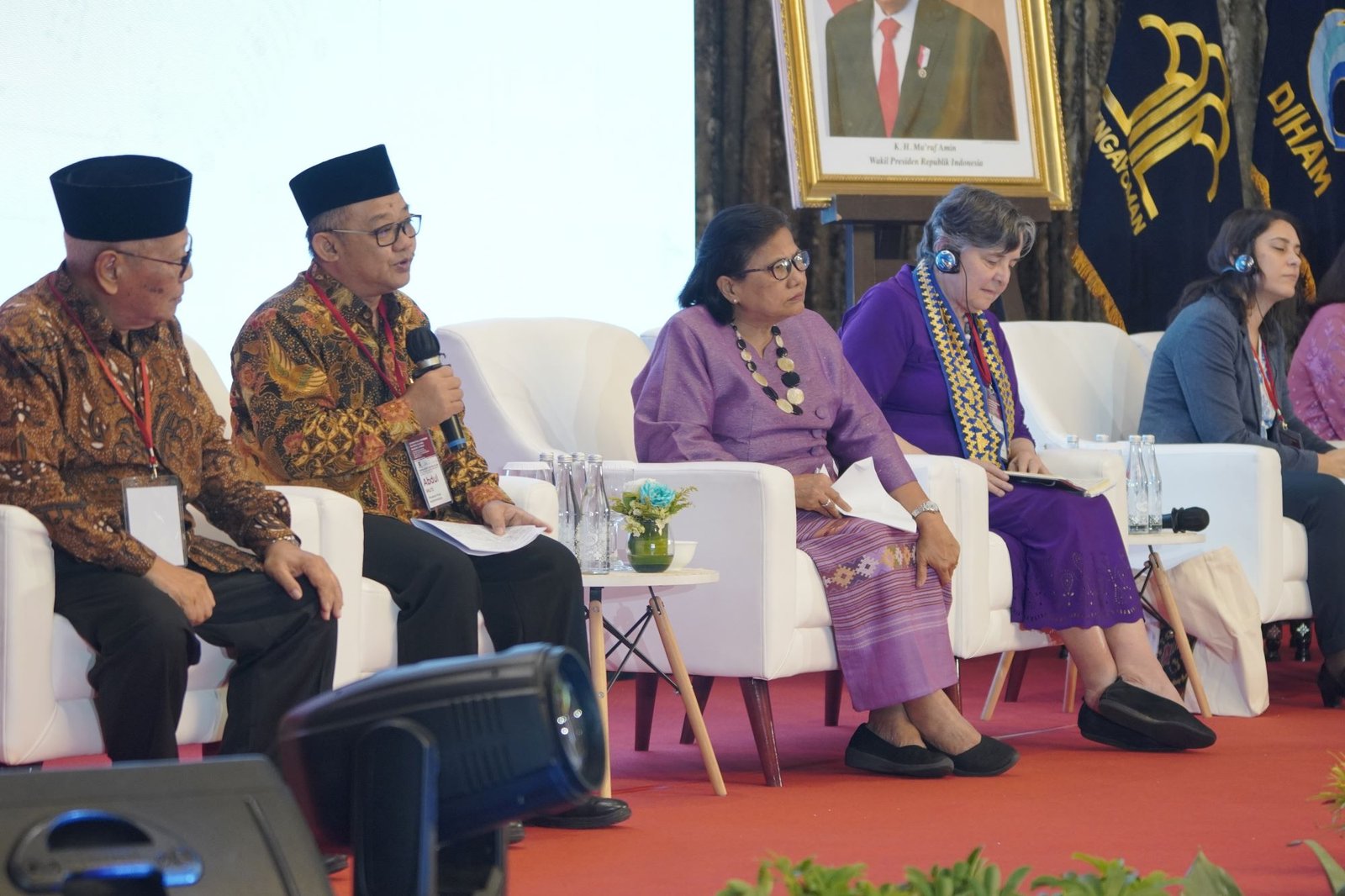
Panel 5 speakers of the International CCRL Conference.
The second is how all faith-based organizations have a common agenda to work together across religions and cultures.
Furthermore, Abdul Mu’ti stressed that in order to build religious engagement in society, the value foundations of all cultures and religions must be strengthened, and faith-based organizations must establish a shared responsibility—namely, the responsibility of building humanity.
“In this way, whatever the forms of humanitarian agendas may be—whether related to issues of violence, human trafficking, or other matters that may threaten human life and safety—they are essentially shared values and shared responsibilities. Thus, we can cross cultural and religious boundaries and live together in peace,” explained Abdul Mu’ti.
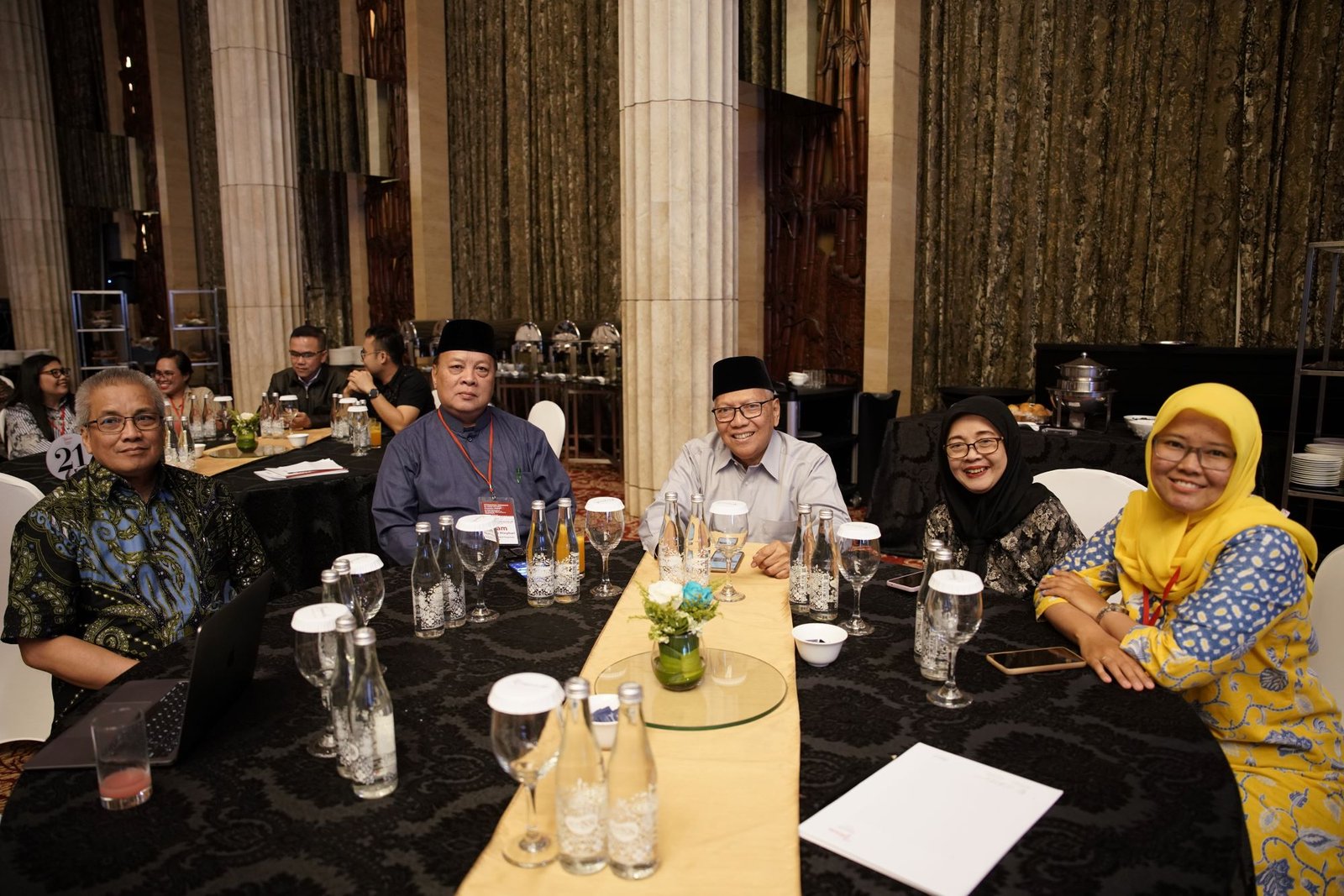
Chairman of the Tebuireng Islamic Boarding School Waqf Foundation, KH Abdul Halim Mahfudz (center, white shirt), during the Dinner Reception at the International CCRL Conference.
At the same event, Chairman of the Tebuireng Islamic Boarding School Waqf Foundation (BWPT), KH Abdul Halim Mahfudz, said that when God created humankind as His noblest creation, there were basic rights that became inseparable from human creation. These basic rights, which constitute human dignity, include the right to life, the right to gather, the right to religion, and the right to enjoy God’s grace.
“Then, behind all of that, we have a primary obligation, which is to care for nature, animals, and plants, and to respect fellow human beings. In Islam, it is taught that no one may violate the basic rights of human dignity. If someone feels entitled to violate them, then they have committed a violation. This is a violation of religion and of God’s decree,” asserted Abdul Halim Mahfudz.
Meanwhile, the President of the Communion of Churches in Indonesia (CCI), Henriette T. Hutabarat-Lebang, revealed that issues of human rights, social discrimination, and the abuse of human dignity have always been at the forefront of discussions in the CCI General Assembly, which is held every five years.
“As a principle, it is believed that all human beings are equal before God. Therefore, human dignity must be upheld regardless of ethnic, cultural, or religious background of each person or community,” said Henriette.
Observing the various conflicts occurring in society, Henriette added that CCI also encourages churches to cooperate with people of other faiths and beliefs in defending human rights and upholding human dignity, especially amidst the many problems being faced.
Meanwhile, Executive Director of the World Faiths Development Dialogue, Katherine Marshall, added that all parties need to find far more effective ways to bring knowledge, wisdom, moral strength, trust, and other assets that are part of the highly diverse and colorful religious world into global agendas.
“We have often heard of the potential and actual roles that religious communities can and have played in peacebuilding. Therefore, they must find effective and efficient ways to bring all this into global agendas, so that human dignity and human rights can continue to be promoted,” explained Katherine.
Furthermore, Director of The Royal Institute for Inter-Faith Studies Jordan, Renee Hattar, expressed that through an appropriate approach—through initiatives of friendship and companionship—faith-based organizations can develop interfaith and intercultural dialogue as an effective tool to counter intolerance, extremism, radicalism, and to foster a culture of mutual respect and understanding.
“These organizations can encourage regional networks on religious and cultural issues through effective communication and interaction. They can then emphasize the role of religion, the role of religious leaders, and religious initiatives in addressing the many issues that undermine human dignity,” stressed Renee Hattar.
Closing the discussion, Dean of the School of General Education and Professor of Anthropology at Brac University, Bangladesh, Samia Huq, added that steps must be taken to face global challenges to human dignity by involving faith-based organizations.