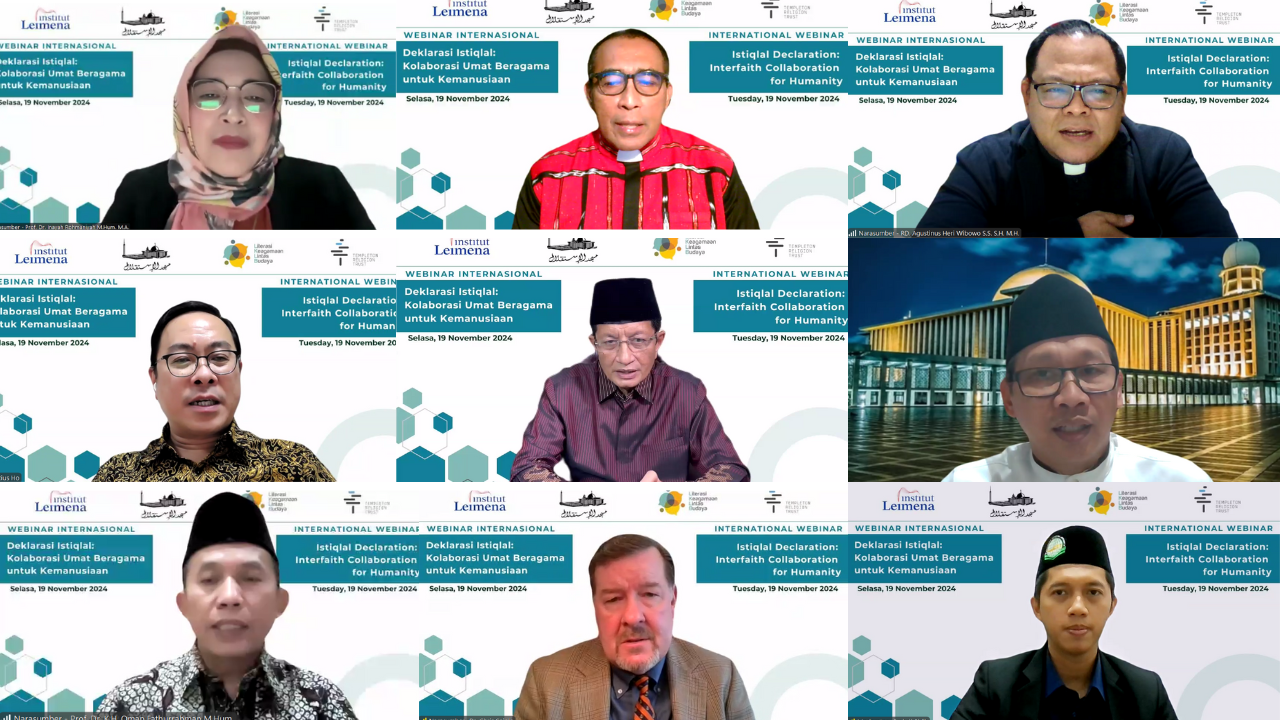
Speakers in the International Webinar Series on Cross-Cultural Religious Literacy with the theme “Istiqlal Declaration: Interfaith Collaboration for Humanity”, November 19, 2024.
Jakarta, LKLB News – The Istiqlal Declaration, signed by the highest leader of the Catholic Church, Pope Francis, and the Grand Imam of Istiqlal Mosque, Nasaruddin Umar, during Pope Francis’ visit to Indonesia on September 5, 2024, affirms the vital role of religion in addressing the various humanitarian crises facing the world today. It is recognized that the Istiqlal Declaration must be followed up with concrete action so that the noble values of religion may continue to live and bring good to society.
This was the essence of the International Webinar Series on Cross-Cultural Religious Literacy (CCRL) themed “Istiqlal Declaration: Interfaith Collaboration for Humanity” organized by Istiqlal Mosque and the Leimena Institute on Tuesday evening (19/11/2024). The Minister of Religious Affairs of the Republic of Indonesia, who is also the Grand Imam of Istiqlal Mosque, Nasaruddin Umar, emphasized that the Istiqlal Declaration is an example of how interfaith encounters have moved into more practical issues such as the environment and interreligious harmony.
“The harmony among human beings, despite their differences, what is it for? To preserve this natural world. Because if the environment is destroyed, the world will surely come to an end,” said Nasaruddin in the webinar, which was attended by more than 2,200 participants.
The Minister explained that the Istiqlal Declaration emphasizes two key points: first, raising the awareness of religious communities to unite and work together in protecting the environment. He stressed that the impact of climate change is tremendously destructive to human life. Second, religious communities must deepen their understanding of their own faith by diligently reading their respective sacred scriptures.
“Our duty as religious leaders is to broaden our religious horizons. I am convinced that if all believers truly internalize the teachings of their sacred scriptures, harmony in life will naturally be created,” said Nasaruddin.
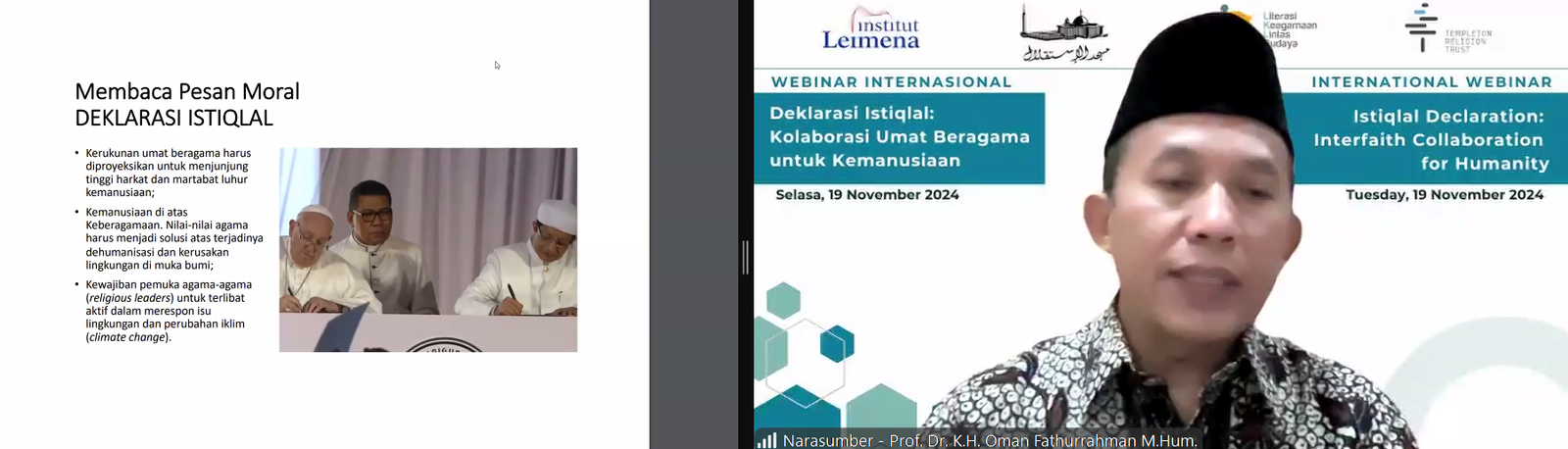
Professor Oman Fathurrahman of Syarif Hidayatullah State Islamic University, Jakarta, explains the meaning of the Istiqlal Declaration.
Professor of Philology at the Faculty of Adab and Humanities, Syarif Hidayatullah State Islamic University (UIN) Jakarta, Oman Fathurrahman, stated that the Istiqlal Declaration carries a moral message that humanity must stand above diversity, and that religious values must serve as solutions to dehumanization and environmental destruction on earth. Here, the role of religious leaders becomes crucial to be actively engaged.
“Religious leaders have an obligation to be actively involved in responding to humanitarian issues such as climate change,” he said.
Meanwhile, the Executive Director of the Leimena Institute, Matius Ho, stated that the Istiqlal Declaration was signed by two religious figures whose lifelong devotion has exemplified the values embodied in the declaration. Pope Francis’ visit to Indonesia was warmly welcomed by people of various faiths and beliefs, who felt close to and inspired by the figure of the global leader of the Catholic Church.
“In the midst of a world filled with division and conflict, his actions and words continually remind humanity to always side with peace, reconciliation, harmony, and humanity,” said Matius.
He added that the Minister of Religious Affairs and Grand Imam of Istiqlal Mosque has long pioneered interfaith dialogue and cooperation to build religious harmony for the sake of humanity.
“The commitment we have witnessed and experienced firsthand through the collaboration between the Leimena Institute and Istiqlal Mosque in the Cross-Cultural Religious Literacy program over the past three years has trained more than 10,000 teachers and educators of different religions from 38 provinces, working in partnership with over 30 religious and educational institutions,” said Matius.
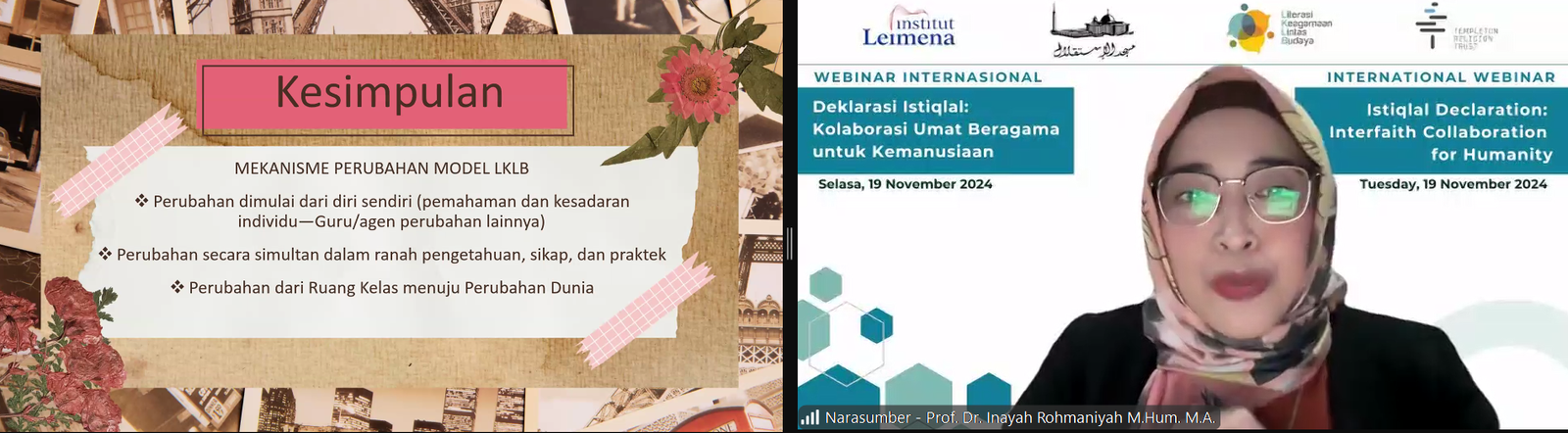
Professor Inayah Rohmaniyah of the Faculty of Ushuluddin and Islamic Thought, UIN Sunan Kalijaga Yogyakarta.
Professor of the Faculty of Ushuluddin and Islamic Thought, UIN Sunan Kalijaga, Inayah Rohmaniyah, stated that one way to ground the Istiqlal Declaration is by focusing on teachers and educators as agents of change within society. For this reason, the Cross-Cultural Religious Literacy (CCRL) program initiated by the Leimena Institute, Istiqlal Mosque, UIN Sunan Kalijaga, and dozens of other partners has sought to train teachers’ competencies and skills in developing a tradition of critical thinking, including in religious education at schools that often emphasize indoctrination.
“We have witnessed firsthand that the mechanism of change through the CCRL model is very effective because it starts with self-understanding, then moves into attitudes, where teachers of different religions sit together, design lesson plans, and collaborate,” said Inayah.
Senior Fellow in Comparative Religion at the Jackson School of International Studies, University of Washington, Chris Seiple, added that Indonesia’s CCRL approach can be illustrated like gado-gado (an Indonesian salad dish). That is, while all the elements mix together, they do not lose their original form; the egg remains egg, the tofu remains tofu, yet when combined they become something very delicious.
“The CCRL approach is the best way to honor one another, each other, and the created world already blessed by God,” said Chris Seiple.