
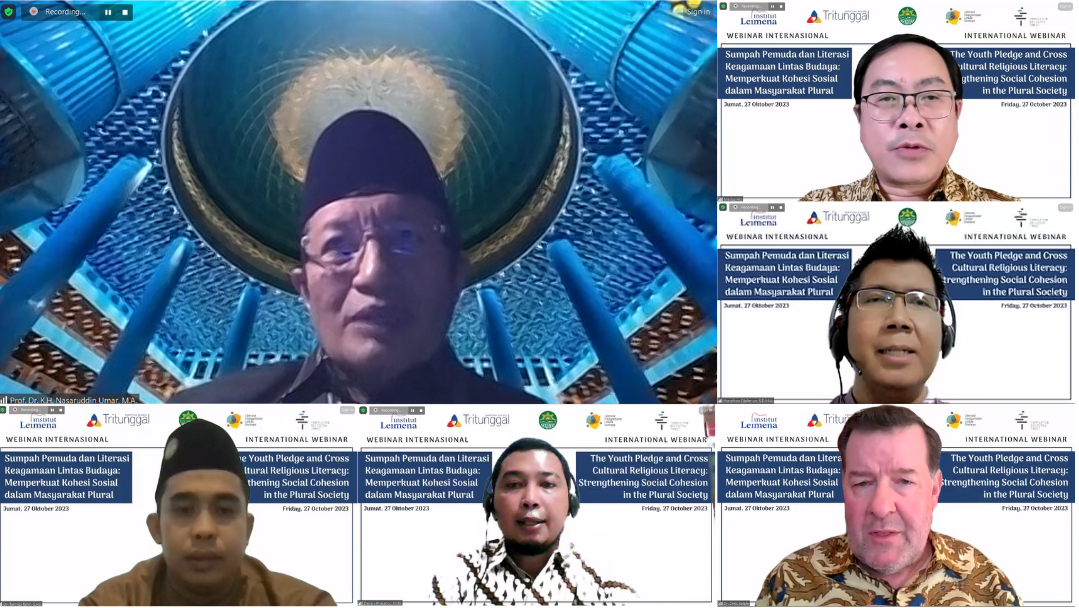
Speakers in the webinar commemorating Youth Pledge Day, organized by Institut Leimena together with Central Pondok Pesantren As’adiyah Sengkang, South Sulawesi, and Tritunggal Christian School, Semarang.
Jakarta, LKLB News – The Youth Pledge, commemorated every October 28, is a reminder of the struggle of youth from various ethnicities, religions, and cultures in Indonesia to unite in building a nation. The Grand Imam of Istiqlal Mosque, Prof. Dr. Nasaruddin Umar, reminded Indonesian youth not to be pessimistic about their own nation, but instead to constantly strive for unity amidst difference and diversity.
“I sincerely hope that Indonesian youth will not spend their time merely disparaging their own nation and admiring other nations. Despite all our shortcomings, we must continue to respect our own nation,” said Nasaruddin in the international webinar themed “The Youth Pledge and Cross-Cultural Religious Literacy: Strengthening Social Cohesion in a Plural Society” organized by Institut Leimena together with Central Pondok Pesantren As’adiyah Sengkang, South Sulawesi, and Tritunggal Christian School, Semarang, on Friday evening (27/10/2023).
Nasaruddin said that Indonesia is like a “piece of paradise” because it has fertile land as well as diverse people and cultures. The Qur’an also mentions diversity, stating that Allah created humanity into nations and tribes. Therefore, today’s Indonesian youth face the challenge of turning differences into strength, not weakness.
Nasaruddin encouraged the youth to study the nation’s history well. Indonesia possesses a social capital from its past, having endured centuries of colonialism. This factor should make it easier for us as children of the nation to work together despite differences in religion, ethnicity, and culture.
“Every religion has experienced colonialism in Indonesia, every ethnicity has felt the hardship of being colonized. This shared history makes us more solid as citizens of the nation,” said Nasaruddin, who is also the Chairman of the Central Board of Pesantren As’adiyah Sengkang.
According to him, the Youth Pledge is proof that from long ago, the desire to unite as one nation had already been proclaimed by youth representatives from across the archipelago. He also noted that Prophet Muhammad SAW valued youth leadership, one example being his appointment of Usamah bin Zaid, then only 19 years old, as a military commander.
Nasaruddin also reminded of the importance of national unity ahead of the 2024 democratic elections. He urged students and academic communities everywhere to uphold unity, and to be resilient youth who remain optimistic about themselves and their nation.
“We may belong to different parties and have different choices, but the nation’s future ideals, God willing, will always support the banner of the Unitary State of the Republic of Indonesia. Whoever is elected leader, we must give our full support. Whoever loses, let it be accepted as a destined reality. If we think this way, Indonesia will become a very strong country in the future,” said Nasaruddin.
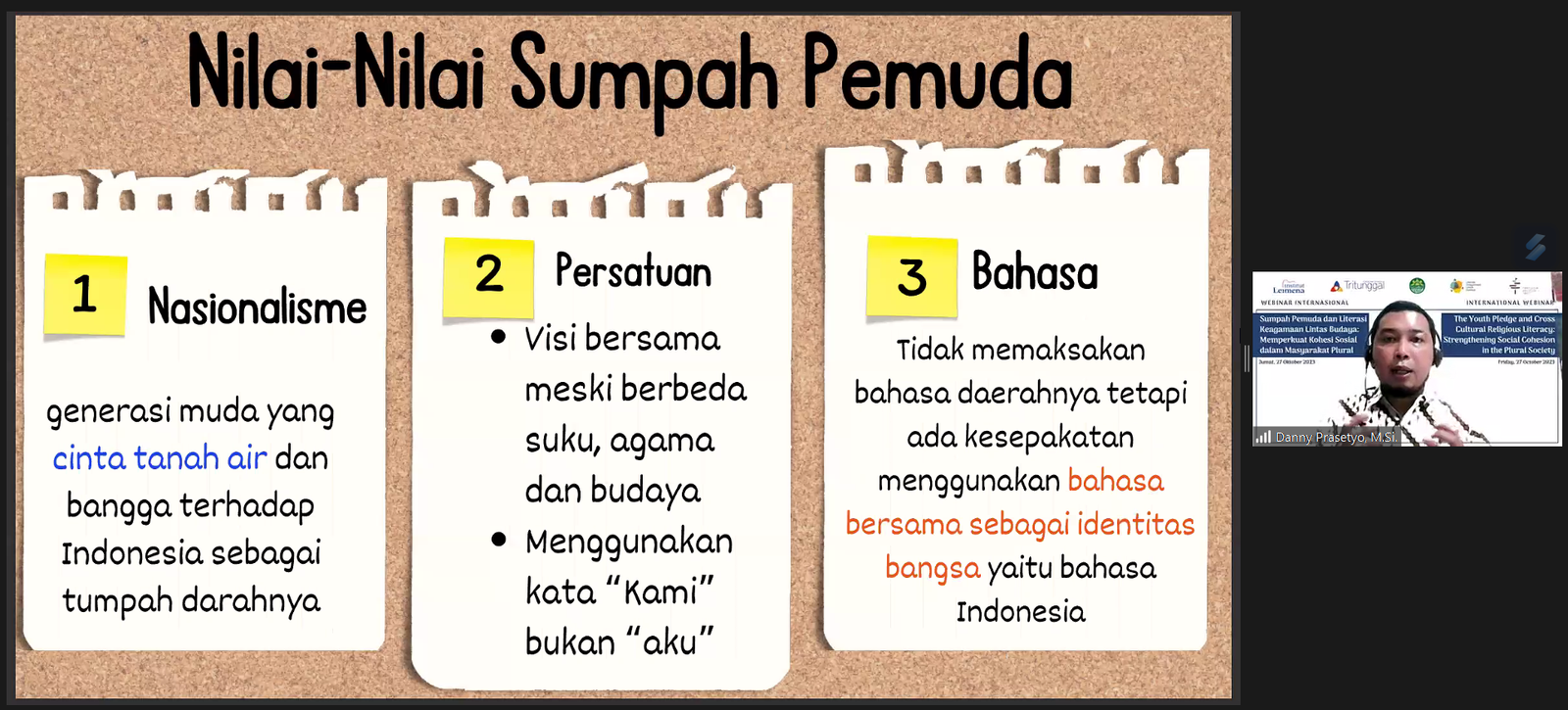
Danny Prasetyo, Teacher at Tritunggal Christian School, Semarang, Central Java
Not ‘I’, But ‘We’
Tritunggal Christian School teacher, Danny Prasetyo, said the 1928 Youth Pledge is evidence that the spirit of unity and pride in the Indonesian homeland had already grown long before independence.
“The emphasis in the Youth Pledge is on the word ‘we,’ not ‘I.’ It means today’s generation must be able to control their ego and personal interests, and instead prioritize the common good, the nation, and the state,” said Danny.
Executive Director of Institut Leimena, Matius Ho, said the Cross-Cultural Religious Literacy (CCRL) program is a joint effort by Institut Leimena and its various partners to continue the spirit and ideals of the Youth Pledge. The program is focused on teachers and religious educators because of the vital role of education in building mutual respect among fellow human beings regardless of differences. Since its launch in 2021, the CCRL program has been attended by at least 5,700 interfaith teachers and religious instructors from 34 provinces.
“In a religious society such as Indonesia, we cannot ignore the importance of developing the willingness and capacity to build relationships and collaborations with followers of other religions and beliefs. Without this, our society will easily be pitted against each other and torn apart,” said Matius.
Meanwhile, Head of the Institute for Research and Community Service at Pesantren As’adiyah, Dr. Tarmizi Tahir, said that pesantren students have a ‘santri pledge’ as an expression of santri nationalism. One of the contents of this pledge is that santri belong to the Unitary State of the Republic of Indonesia, which is based on Pancasila, the 1945 Constitution, and the culture of Bhinneka Tunggal Ika (Unity in Diversity).