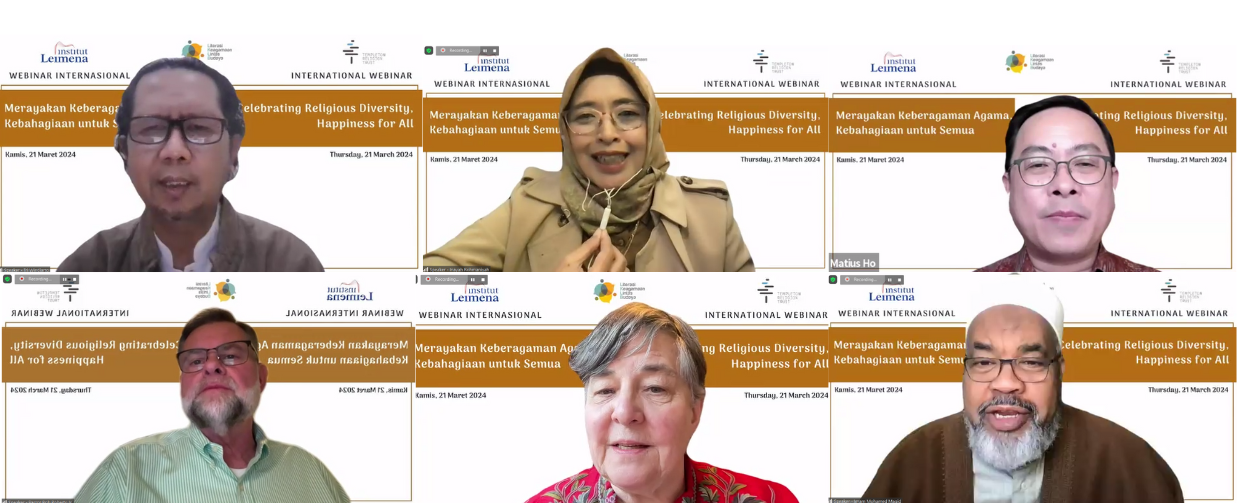
The international webinar speakers for International Day of Happiness organized by Institut Leimena, March 21, 2024.
Jakarta, LKLB News – The International Day of Happiness, commemorated every March 20, carries an important meaning for Indonesia’s plural society. Mutual trust and tolerance toward people of different religions significantly influence the growth of happiness within individuals.
“The World Happiness Report 2023, issued by the United Nations, shows that people living in environments with high levels of social and institutional trust are happier compared to those in environments with low trust—marked by suspicion and lack of confidence in institutions,” said the Executive Director of Institut Leimena, Matius Ho, during the International Webinar on Cross-Cultural Religious Literacy (CCRL) on Thursday evening, March 21, 2024.
The webinar, themed “Celebrating Religious Diversity, Happiness for All”, was held to commemorate the International Day of Happiness, which was established by the UN General Assembly in 2012 through Resolution 66/281.
Matius explained that the UN designated this day in recognition of the pursuit of happiness as one of humanity’s fundamental goals. In the UN’s 2013 report, it was found that the 2007–2008 financial crisis had a smaller impact on happiness in countries with higher levels of trust. According to Matius, these findings align with many other studies showing that communities with stronger mutual trust are generally more resilient in facing crises and disasters.
“Trust, along with norms, habits, and the ability to work together, enables societies to respond more swiftly to shared challenges and to be more willing to help one another—ultimately increasing people’s happiness,” Matius said.
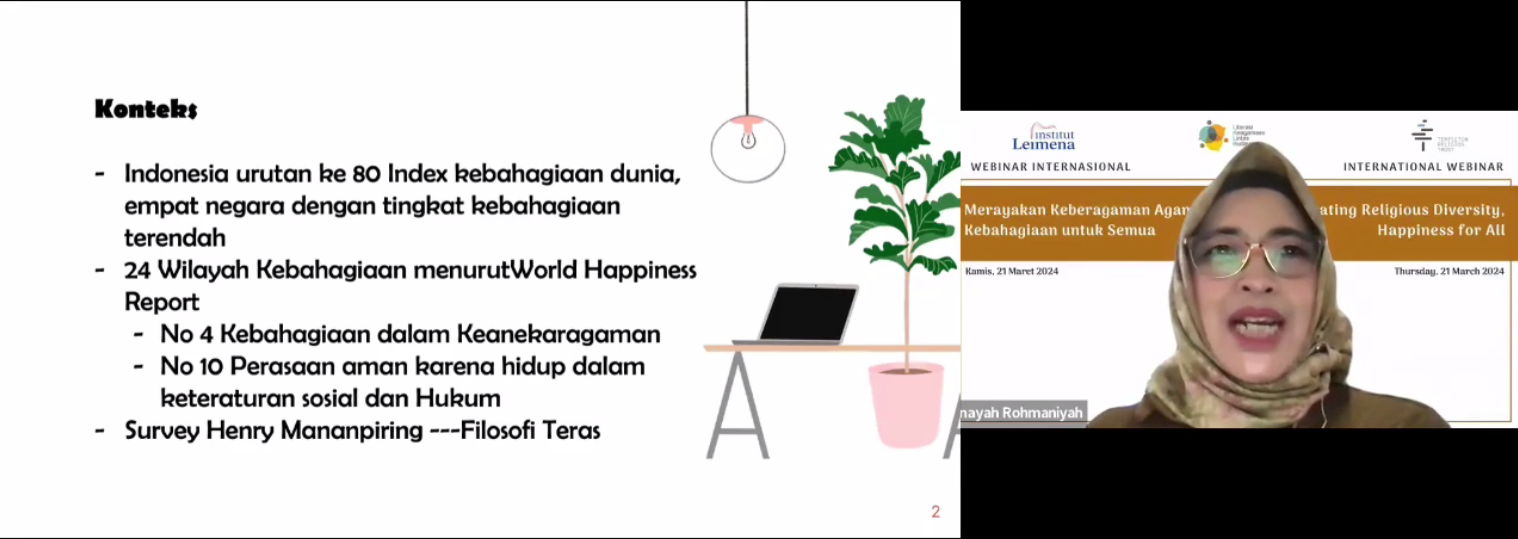
Dean of the Faculty of Ushuluddin and Islamic Thought, Sunan Kalijaga State Islamic University, Prof. Inayah Rohmaniyah.
Matius added that the CCRL program, organized by Institut Leimena in collaboration with 25 religious and educational institutions, has involved at least 7,000 educators from 37 provinces in Indonesia. The program emphasizes building trust, based on the understanding that in a plural society, people need not only the ability to dialogue but also the skills to work together across religious differences.
“Collaboration is key to building trust. One of the three CCRL competencies is collaborative competence, which means that even though we may differ in religion and belief, we must be able to find common ground and ways to work together, while still respecting our differences,” Matius explained.
Similarly, Tri Windiarto, Associate Statistician at the Directorate of Social Resilience Statistics, Statistics Indonesia (BPS), said that one factor influencing happiness is social relationships within the community. These relationships are measured through three aspects: trust, social participation, and tolerance.
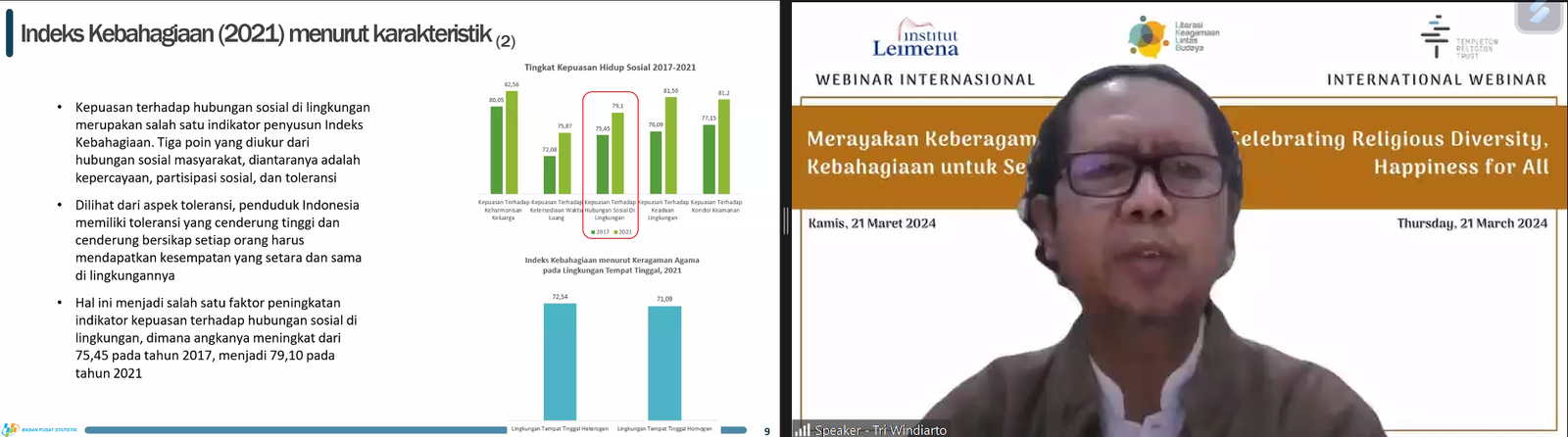
Senior Statistician of the Directorate of Social Resilience Statistics at Statistics Indonesia (BPS), Tri Windiarto.
Happiness Survey
Tri explained that BPS has conducted the Happiness Level Measurement Survey (SPTK) in 2014, 2017, and most recently in 2021. The survey is based on the mandate of the Constitution of the Republic of Indonesia to promote public well-being, which the nation’s founders understood not only as material prosperity but also as encompassing happiness.
The 2021 Happiness Index stood at 71.49 percent, higher than the 70.69 percent recorded in 2017. The 2021 survey covered 75,000 households across 34 provinces and 514 districts/cities in Indonesia. The index measures three dimensions—life satisfaction, affect (good life), and meaning of life—which follow the framework of the Organisation for Economic Co-operation and Development (OECD).
“The Happiness Index supports the idea that happiness can come from various factors, not only material but also non-material,” Tri said.
He noted that the survey shows tolerance in Indonesia tends to be high. For example, people allow others to practice their religious rituals even if their interpretation of truth differs, and members of a religious majority acknowledge they have no right to control or restrict the practices of minority communities.
Prof. Inayah Rohmaniyah, Dean of the Faculty of Ushuluddin and Islamic Thought at Sunan Kalijaga State Islamic University, one of the partners of Institut Leimena in developing the CCRL workshop modules, said that the program provides not only new perspectives but also practical skills educators can apply. The three CCRL competencies are personal, comparative, and collaborative, supported by skills in evaluation, negotiation, and communication.
“After ensuring participants master these skills, we also provide them with direct experiences of interacting with people of different religions. For most teachers, this becomes a transcendent experience,” said Inayah.
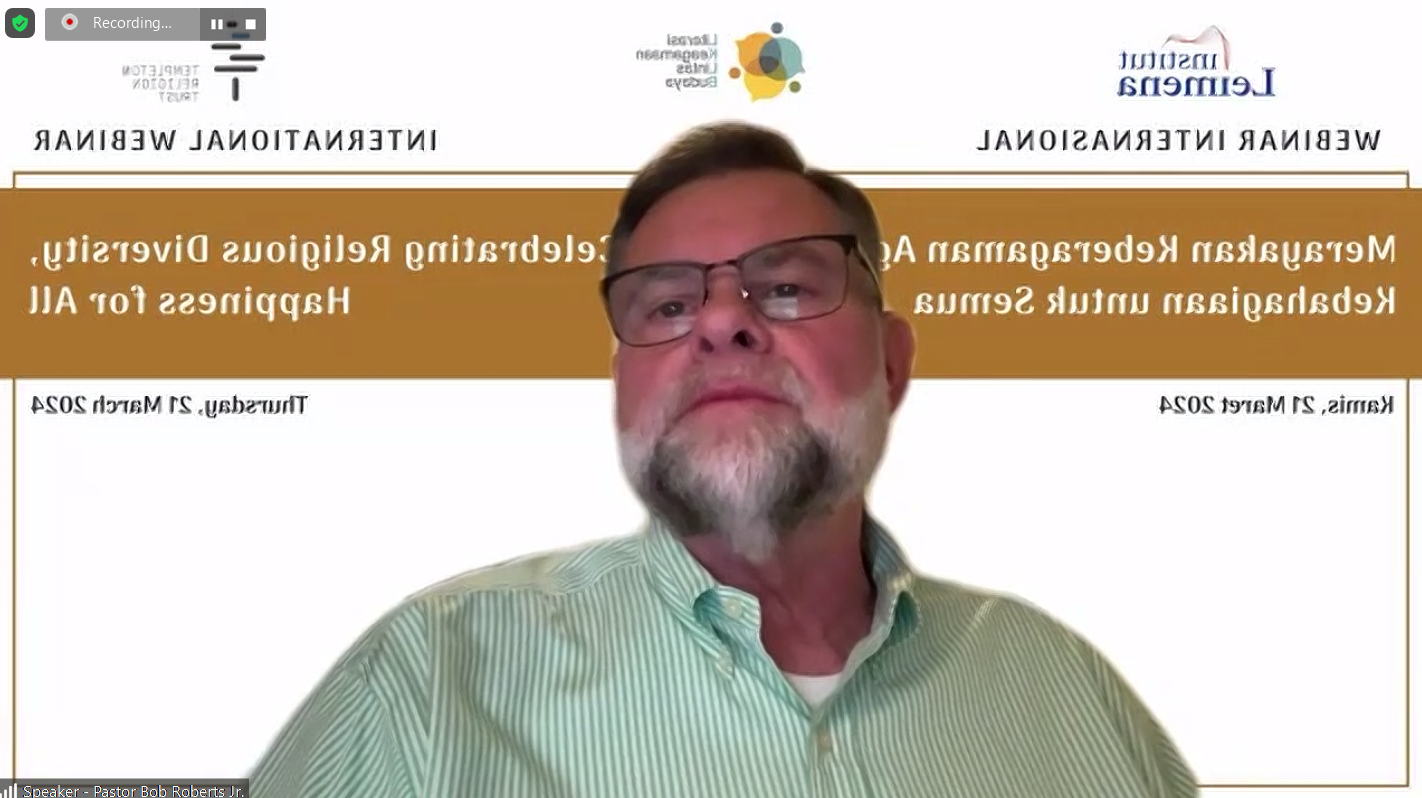
Founder of Multi-Faith Neighbors Network, Pastor Bob Roberts Jr.
Pastor Bob Roberts Jr. and Imam Mohamed Magid, co-founders of the Multi-Faith Neighbors Network based in Texas, USA, shared their experiences in building interfaith relationships among religious leaders. Pastor Bob emphasized that when people work and strive together, it opens the way to deeper conversations because of a shared sense of purpose and growing trust.
“When pastors, imams, rabbis, and other religious leaders gather to learn from each other, they set an example for their respective faith communities,” Pastor Bob said.
Katherine Marshall, Vice President of the G20 Interfaith Association (IF20), added that cross-cultural religious literacy helps address fears rooted in ignorance of others. “By increasing knowledge, people can better understand how to interact with those who are different,” she said.